
Useful Informationuseful information
Here we share things that Stat Agent has found useful in everyday work!
2017/10/17 How to Write Reports and Papers: Editing Guidelines — 10 Checkpoints
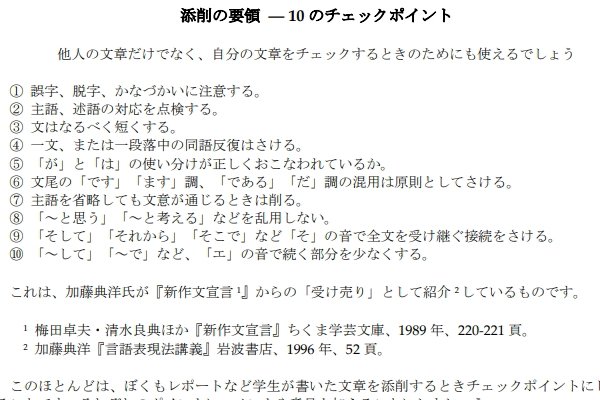
1. Check for typographical errors, omissions, and correct kana usage. 2. Check that subjects and predicates correspond correctly. 3. Keep sentences as short as reasonably possible. 4. Avoid unnecessary repetition of the same word within a sentence or paragraph. 5. Check whether the Japanese particles “ga” and “wa” are being used appropriately. 6. As a general rule, avoid mixing polite “desu/masu” style with plain “de aru/da” style. 7. Omit the subject when the meaning remains clear without it. 8. Avoid overusing expressions such as “I think” and “I consider.” 9. Avoid repeatedly connecting sentences with Japanese conjunctions beginning with the “so” sound, such as “soshite,” “sorekara,” and “sokode.” 10. Reduce sequences of phrases that end with sounds such as “-shite” and “-de.” These points were introduced by Norihiro Kato as guidance borrowed from “Shin Sakubun Sengen 1.”
1 Takuo Umeda, Yoshinori Shimizu et al., “Shin Sakubun Sengen,” Chikuma Gakugei Bunko, 1989, pp. 220–221.
2 Norihiro Kato, “Gengo Hyogenho Kogi,” Iwanami Shoten, 1996, p. 52.
Most of these are checkpoints used when editing reports and other writing by students. Let us add comments and observations to each point.
Source:http://www.nagasaki-gaigo.ac.jp/toguchi/composition/
2017/09/12 How to Indicate Quotations and Sources
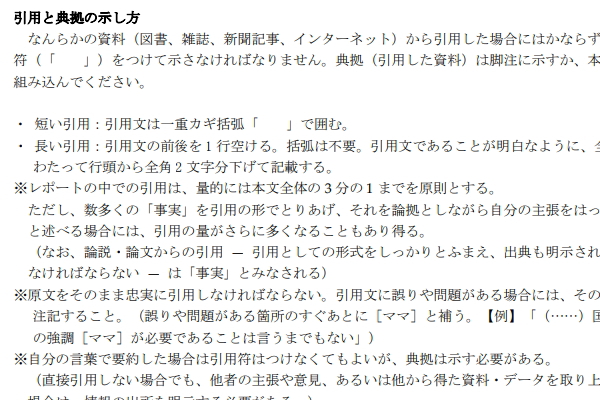
Whenever you quote from any source—books, magazines, newspaper articles, or the Internet—you must clearly indicate the quotation with quotation marks. The source must be given in a footnote or incorporated into the main text.
• Short quotations: Enclose the quoted passage in quotation marks.
• Long quotations: Leave one blank line before and after the passage. Quotation marks are unnecessary. Make it visually clear that it is a quotation by indenting the entire passage.
* As a general rule, quotations in a report should not exceed one-third of the total main text.
However, if many “facts” are presented in quoted form and used as evidence while the writer clearly develops their own argument, the amount of quoted material may be greater. Quotations from essays or academic papers are treated as “facts” only when the proper quotation format is followed and the source is clearly identified.
* The original text must be quoted faithfully. If the quoted passage contains an error or problematic wording, note that fact immediately after the relevant portion, for example by adding “[sic].”
* If you summarize in your own words, quotation marks are not required, but the source must still be cited.
Even when not quoting directly, if you refer to another person's claim or opinion, or use materials or data obtained elsewhere, you must clearly identify the source of the information.
* For details on quotation style and footnotes, see the separate handout “How to Quote and Add Notes: Examples.”
Source:http://www.nagasaki-gaigo.ac.jp/toguchi/composition/citation.pdf
2017/08/19 How to Use Word's Footnote Function
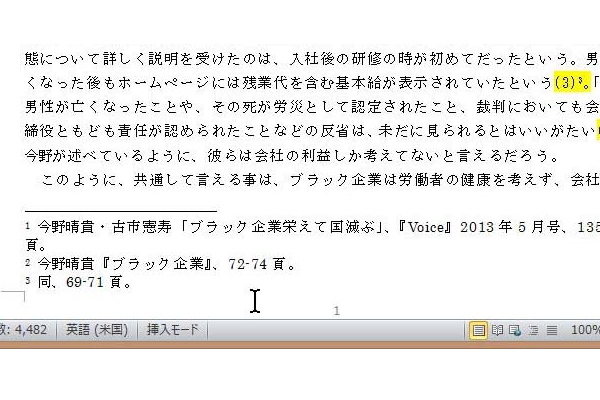
When referring to literature or data in papers and reports, you may summarize the material in your own words or quote it directly, but in either case you must identify the source. This section explains how to indicate sources using Microsoft Word's footnote function.
In this example, a total of 11 notes will be added. As shown below, the locations for notes are pre-marked with numbers (1) through (11) and highlighted in yellow for clarity. When actually writing a report or paper, Word automatically assigns the note numbers.
Source:http://www.nagasaki-gaigo.ac.jp/toguchi/composition/footnote_how-to/footnote_how-to.htm
Contact Us
Over 30,000 consultations / Over 19,000 completed engagements. To date, we have supported consultations and requests involving analysis outsourcing, statistical processing, questionnaire surveys, marketing support, and more. Our experienced consultants carefully listen to your needs so that we can provide the right support. We offer prompt and accurate work at reasonable, accessible rates and are committed to delivering dependable results. Stat Agent team members across Japan will take responsibility for supporting you.
*We provide the profile of the person responsible for your project when you apply.
For outsourced analysis and statistical processing, choose Stat Agent.
*When order volume is high, it may be difficult to reach us by phone.
We apologize for the inconvenience. We respond in order of receipt, so if your matter is urgent, please contact us by
