
Qualitative Analysis Case StudyQualitative research and analysis case
Here we present a case study ofQualitative Analysis Case Studyour support involvinginterview analysis using M-GTA, transcript analysis, categorization, and storyline developmentThis page introduces a support case involving these services.
Stat Agent does more than simply summarize what participants said. We provide integrated support includingorganization of the analytical theme, definition of the analytically focused person, coding, concept generation, categorization, preparation of a results diagram, storyline development, and formatting of Excel deliverables.
This case is also useful for those who are unsure how to analyze interview findings, are concerned about preparing M-GTA worksheets, or want qualitative findings organized in a form suitable for academic papers or research reports.
Please note thatto protect privacy, portions of the title and text have been adjusted, and published images have also been processed.Thank you for your understanding.
Case Study: Interview Analysis Using M-GTA
Step 1 | Reviewing the Data and Aligning on the Intended Final Output
First, we carefully review the client's interview data, transcripts, research objectives, and what the analysis is intended to clarify.
In this case,“Interview analysis using M-GTA”was the selected approach, and the client provided text data from interviews with five participants.
Even if transcripts have not yet been prepared, Stat Agent can create transcripts from audio files, organize utterances, remove unnecessary sections, and process the data into a format suitable for analysis.
At this stage, we confirmthe research objective, who will be defined as the analytically focused person, and how far the deliverables should extend—for example, Excel worksheets, a results diagram, and a storyline.This allows us to share a clear image of the final deliverables.
Even when no highly detailed specifications are provided, we can propose a structure that is appropriate for qualitative analysis based on the research topic, participants, interview content, and required submission format.
When AI is used, we do not merely classify utterances mechanically. We also reviewthe context, background of the narrative, speaker intent, and relationship to the research objectivethrough human judgment, allowing the output to be organized as research-ready qualitative analysis rather than a simple summary.
 Step 2 | Analyzing Data Based on the M-GTA Framework
After the data and intended final output have been confirmed, we analyze the interview data according to the M-GTA procedure.
M-GTA refers to theModified Grounded Theory Approachand is a method for constructing concepts, categories, results diagrams, and storylines from qualitative data such as interviews and open-ended responses.
M-GTA involves more than simply classifying statements. It is important to identify meaningful units within the data, generate concepts in relation to the research theme, and organize relationships among those concepts.
In this case, the work followed the steps below.
1. Define the analytical theme and analytically focused person
2. Review transcripts and identify portions relevant to analysis
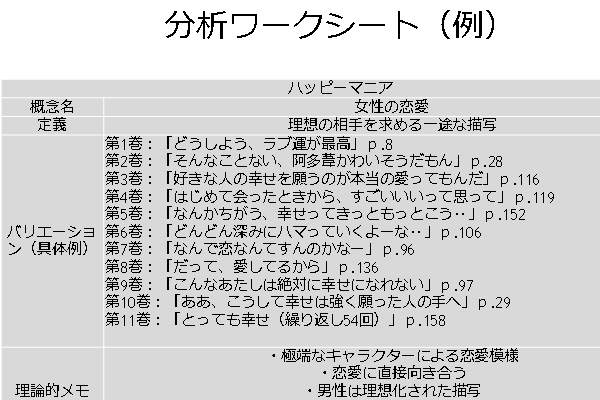
3. Prepare examples, definitions, and theoretical memos using analytical worksheets
4. Generate concepts and refine concept names
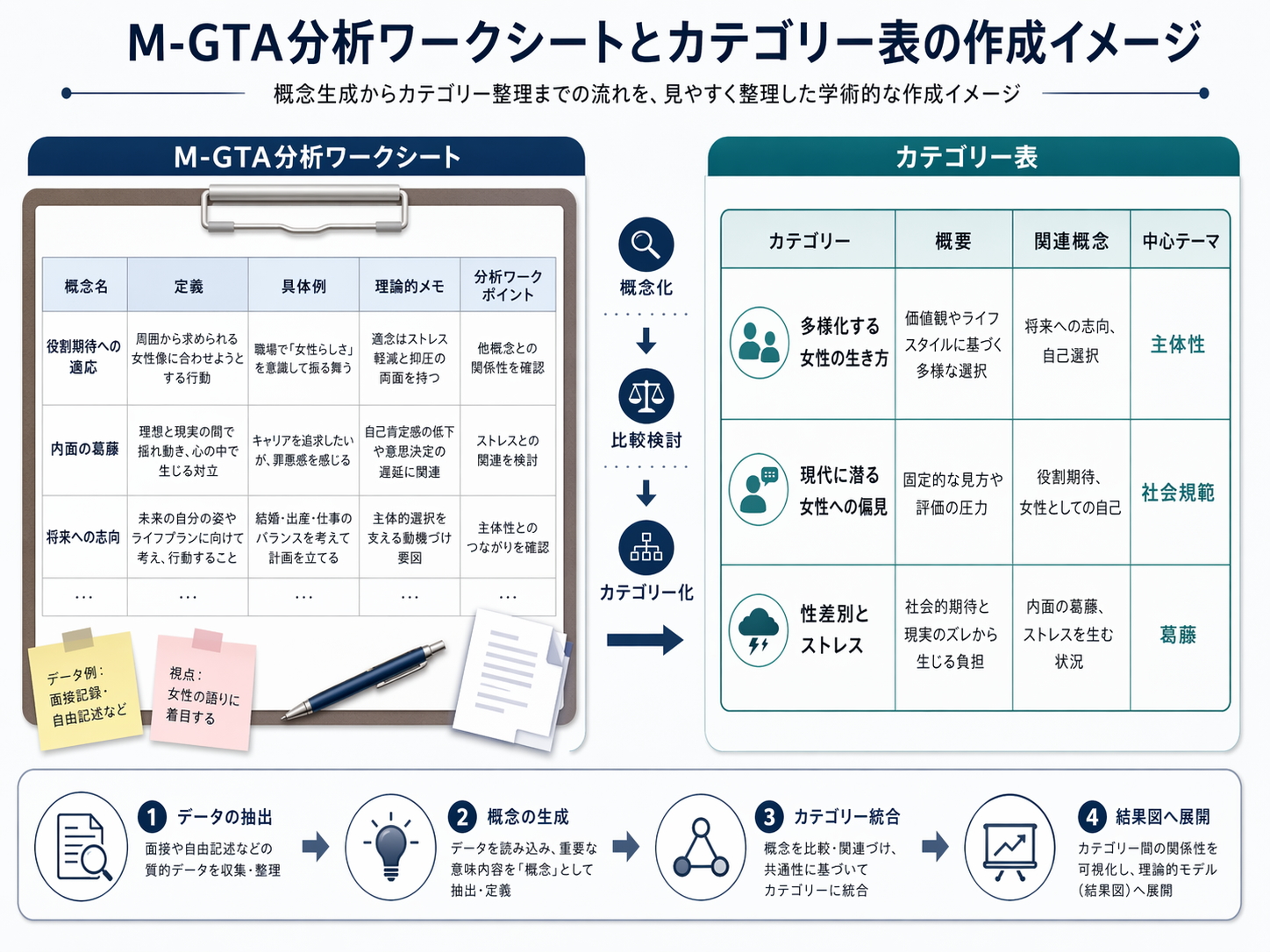
5. Generate subcategories and categories
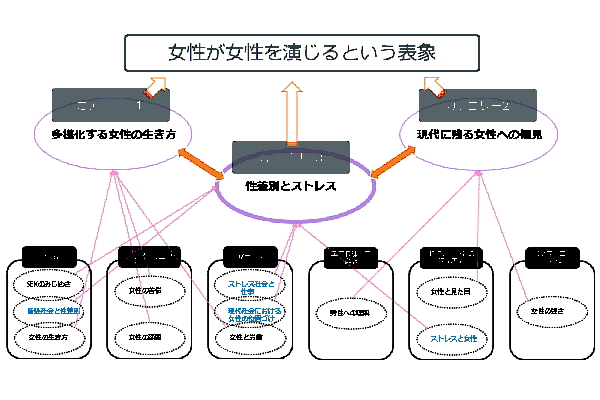
6. Prepare a results diagram
7. Develop a storyline
8. Organize considerations related to theoretical saturation
CarefulBy integrating organization of utterances, conceptualization, categorization, the results diagram, and the storyline,we prepare qualitative-analysis deliverables that can be readily used in academic papers, research reports, and conference presentation materials.
Step 3 | Preparing Analytical Worksheets and Category Tables
In qualitative analysis using M-GTA, preparation of analytical worksheets is an important step.
In the analytical worksheet, we organize concept names, definitions, concrete examples, theoretical memos, and related information so that it is possible to trace which statements were used to generate each concept.
Careful completion of this process clarifies the basis for the analysis and makes it easier to explain to readers why particular categories were derived.
Stat Agent accepts a wide range of consultations regardingWhile human reviewers examine the context and meaning of statements, AI may also be used as a supplementary tool to identify similar expressions, duplicate concepts, relationships among categories, and areas where explanations may be insufficient,thereby helping refine the work intological and reproducible qualitative analysis.
Nuances in statements, alignment with research objectives, and interpretations grounded in participant background that may be difficult for AI alone to identify are carefully reviewed by people.
As a result, the output is not merely automated classification, but can be structured in a form that is easier to explain in an academic paper or research report.
Step 4 | Preparing the Results Diagram and Storyline
After concepts and categories have been organized, we prepare the results diagram and storyline.
The results diagram visually presents relationships among the generated concepts and categories and organizes the overall analytical structure in an easy-to-understand way.
The storyline connects the analytical findings in narrative form and explains how participants' experiences, behaviors, changes in perceptions, and background factors relate to one another.
In qualitative analysis, it is not enough simply to list categories. It is also important to determinehow the relationships among categories should be interpreted.is extremely important.
Stat Agent checks the results diagram and storyline together and adjusts them so that the explanation is understandable to readers and aligned with the research objective.
Step 5 | Finalizing the Analysis and Adjusting the Delivery Format
Finally, we review the analytical worksheets, category tables, results diagram, and storyline as a whole and organize them in a form suitable for submission and sharing.
At this stage, we do more than simply check for typographical errors. We confirmconsistency between concept names and definitions,、correspondence between concrete examples and categories,、consistency between the results diagram and storyline, and、connection to the research objectiveare reviewed carefully.
Deliverables are normally provided inExcel format,allowing clients to edit, add to, or adjust the files themselves after delivery.
Depending on your needs, we can also provide a report in Word, a results diagram for PowerPoint, tables that can be pasted into a manuscript, or summary materials for conference presentations.
Through this workflow, Stat Agent provides integrated support forM-GTA, interview analysis, transcript analysis, qualitative analysis outsourcing, text analysis, categorization, and storyline development
Before production begins, we carefully confirm the required level of detail, number of participants, transcript length, worksheet detail, results-diagram format, and delivery format. If revisions or additional requests arise during production, we respond flexibly where feasible.
Standard delivery:Delivery in 7 days
Expedited delivery:Delivery within 2 days may also be available
* We also offer detailed customization for the KJ Method, thematic analysis, text mining, analysis using KH Coder or NVivo, analysis of English-language interviews, and related needs.
Contact Us
Over 30,000 consultations / Over 19,000 completed engagements. To date, we have supported consultations and requests involving analysis outsourcing, statistical processing, questionnaire surveys, marketing support, and more. Our experienced consultants carefully listen to your needs so that we can provide the right support. We offer prompt and accurate work at reasonable, accessible rates and are committed to delivering dependable results. Stat Agent team members across Japan will take responsibility for supporting you.
*We provide the profile of the person responsible for your project when you apply.
For outsourced analysis and statistical processing, choose Stat Agent.
*When order volume is high, it may be difficult to reach us by phone.
We apologize for the inconvenience. We respond in order of receipt, so if your matter is urgent, please contact us by
