
Qualitative Research and SCAT
For those unsure how to analyze interviews and open-ended responses in undergraduate or master's theses, nursing research, education research, or social-welfare research
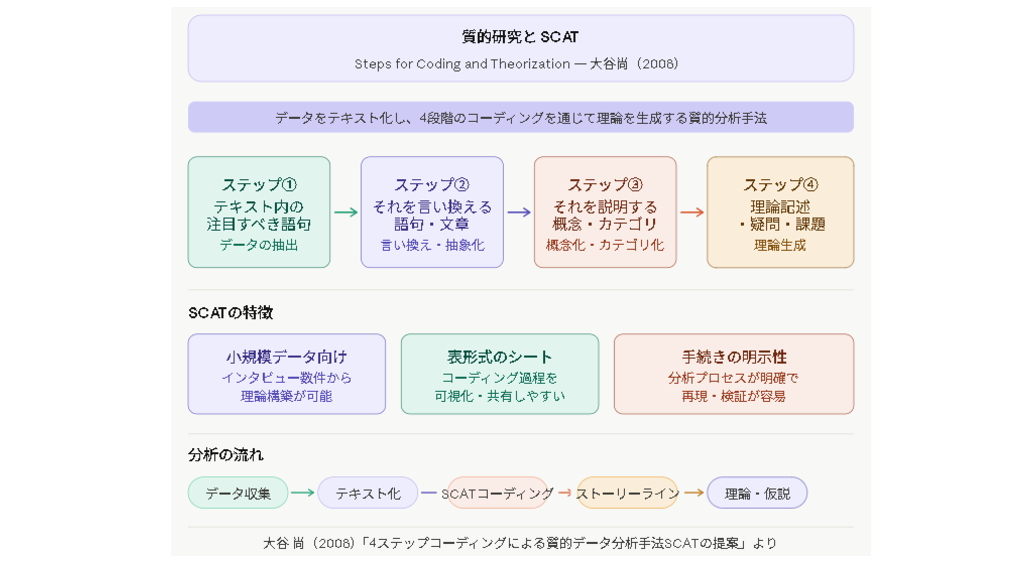
Qualitative research analyzes experiences and meanings that are difficult to capture with numbers alone, using interview transcripts, open-ended responses, observational records, practice records, field notes, and related materials. When actual analysis begins, however, many researchers struggle with questions such as "Where should coding begin?" and "How should the analysis results be written in a paper?" .
One method used for this kind of qualitative data analysis is SCAT(Steps for Coding and Theorization) . SCAT is relatively easy to apply to small-scale qualitative datasets and organizes utterances or written responses through stepwise coding, leading to a storyline and theoretical description. It is used in areas such as nursing, education, psychology, social welfare, health and welfare, community studies, practice-based research, undergraduate theses, and master's theses.
This article is intended for readers considering qualitative research SCAT、 SCAT analysis、 how to write SCAT、 qualitative data analysis methods、 interview analysis、 open-ended response analysis、 undergraduate thesis SCAT、 master's thesis SCAT、 nursing research SCAT For readers searching for topics such as these, this article explains the basic concepts of SCAT, the analysis procedure, how to report it in a paper, and important cautions.
The first point to understand is that SCAT is not simply a way to organize impressions; it is a qualitative analytical method for deriving concepts and structures of meaning from textual data in a stepwise manner . Merely shortening utterances is insufficient. Coding, conceptualization, storyline development, and theoretical description should be organized consistently.
- • What Is Qualitative Research?
- • What Is SCAT?
- • Research Topics Suited to SCAT
- • Basic SCAT Analysis Procedure
- • Four-Step Coding in SCAT
- • How to Write a Storyline
- • How to Write a Theoretical Description
- • Structuring Undergraduate and Master's Theses That Use SCAT
- • Applications in Nursing, Education, and Social-Welfare Research
- • Examples of Reporting SCAT Results
- • Common SCAT Reporting Mistakes
- • SCAT Support Available from Stat Agent
- • Frequently Asked Questions
- • Summary
What Is Qualitative Research?
Qualitative research seeks to understand people's experiences, narratives, behavior, meaning-making, values, relationships, and processes of practice through language and context. It aims to clarify questions such as why people feel a certain way, how change occurs over time, and what an experience means to those involved—questions that are difficult to capture using numerical data alone.
Examples of topics well suited to qualitative research include how patients make sense of illness, how students experience learning difficulties, what conflicts welfare professionals face in support settings, and how residents interpret participation in community-development activities. Such studies require careful reading of participants' narratives in order to analyze the meanings and structures underlying what is said .
Difference from Quantitative Research
Quantitative research uses numerical data such as questionnaire scores, test values, scale scores, counts, and percentages to examine patterns, associations, and differences statistically. Qualitative research, by contrast, interprets interview narratives, open-ended responses, observational records, and similar data to understand participants' experiences and meanings.
Where quantitative research is strong at examining "how much," "whether there is a difference," or "whether variables are associated," qualitative research is strong at clarifying "how something is experienced," "what meaning it has," and "what process is involved." Depending on the research objective, researchers may choose quantitative, qualitative, or mixed-methods designs.
Types of Data Used in Qualitative Research
Qualitative data can include semi-structured interviews, group interviews, open-ended responses, observational records, practice records, diaries, meeting minutes, and field notes. These materials should be interpreted not only by counting words but also in light of context, narrative flow, participant position, and the research objective.
SCAT is useful for organizing such textual data step by step, deriving concepts from utterances or written responses, and ultimately developing a storyline and theoretical description.
What Is SCAT?
SCAT stands for Steps for Coding and Theorization. It is a qualitative analysis method that codes textual data step by step and develops a theoretical description from the resulting concepts. In practice, it involves identifying noteworthy words or phrases in the text, paraphrasing them, abstracting them into explanatory concepts, and organizing them into themes or constructs.
A key feature of SCAT is that the analytical procedure is relatively explicit and easy to document in a table. This makes it useful for undergraduate and master's research, where the analysis process must be explained to supervisors and readers. It can also treat each narrative carefully when the number of interview participants or open-ended responses is limited.
However, SCAT is not a method in which researchers merely fill in a table mechanically. It requires reading the context of the text, interpreting meaning in light of the research objective, and examining relationships among concepts. Therefore, both procedural clarity and interpretive validity are important in SCAT analysis .
Research Topics Suited to SCAT
SCAT is well suited to studies seeking to clarify participants' experiences, perceptions, awareness, conflicts, learning, support processes, and practical knowledge. It is particularly useful when a small number of interviews or open-ended responses need to be read deeply in order to extract coherent patterns of meaning.
Using SCAT for Interview Analysis
In semi-structured interviews, participants speak freely about their experiences. SCAT can identify important expressions in those narratives, paraphrase them according to the research objective, conceptualize them, and ultimately organize them into a storyline.
Topics such as difficulties experienced by novice nurses, parents' perceptions of parenting support, students' experiences with online classes, and residents' motivations for community participation can be suitable for organizing narrative meaning through SCAT.
Using SCAT for Open-Ended Response Analysis
Responses written in open-ended questionnaire fields can also be analyzed with SCAT. Although individual responses may be short, they can contain respondents' anxieties, expectations, evaluations, requests, and experiences.
If open-ended responses are extremely short or many consist only of single words, simple tabulation, content analysis, text mining, or category classification may be more appropriate than SCAT. The method should be selected according to the research objective and richness of the data.
Basic SCAT Analysis Procedure
SCAT begins by reading interview transcripts or open-ended responses and dividing the text into meaningful units. For each unit, the researcher identifies noteworthy words or phrases, paraphrases them using words outside the original text, develops explanatory concepts, and organizes themes or constructs. A storyline is then created from the resulting themes and constructs and further developed into a theoretical description.
| Stage | Main Task |
|---|---|
| Data Preparation | Organize interview transcripts, open-ended responses, observational records, and related materials |
| Text Segmentation | Divide utterances or written responses into meaningful units |
| Four-Step Coding | Organize noteworthy phrases, paraphrases, explanatory concepts, and themes/constructs |
| Storyline Development | Write the analytical findings as a coherent flow of meaning |
| Theoretical Description | Abstract the findings and summarize them theoretically in line with the research objective |
SCAT allows the analytical process to be shown step by step. The Methods section should therefore explain what data were analyzed, how they were segmented, and how coding proceeded.
Four-Step Coding in SCAT
The core of SCAT is four-step coding. This process organizes the progression from extracting expressions directly from the text to adding researcher interpretation and forming concepts.
| Step | Description |
|---|---|
| 1. Noteworthy Words and Phrases | Extract important words or expressions in the text that relate to the research objective |
| 2. Words or Phrases Outside the Text | Paraphrase the extracted wording using more general or research-oriented language |
| 3. Explanatory Words or Phrases | Assign a concept that explains what the utterance or written response means |
| 4. Themes / Constructs | Organize the result as a theme or concept positioned within the overall analysis |
It is important not to move too far away from the original utterance. Researcher interpretation is necessary, but reading meanings into the data that participants did not actually express can weaken validity. SCAT should be conducted while checking the connections among the raw data, codes, concepts, and storyline.
How to Write a Storyline
A storyline uses the themes and constructs extracted through SCAT to explain the experience or phenomenon being analyzed as a coherent narrative. Rather than merely listing codes, it describes the flow and structural meaning of participants' experiences.
For example, suppose analysis of novice nurses' experiences produces constructs such as "anxiety about duties," "support from senior colleagues," "self-understanding through experiences of failure," and "growth through interaction with patients." The storyline should not present these separately; it should describe the process by which novice nurses confront their duties with anxiety and deepen practical learning through support and experiences of failure.
When writing a storyline, consider "who experienced what, in what situation, how they made sense of it, and what change occurred" to improve clarity.
How to Write a Theoretical Description
A theoretical description takes the storyline one level further in abstraction and concisely organizes the insights obtained about the phenomenon under study. It is an important bridge to the study's conclusion and discussion and is not merely a personal impression or summary.
Theoretical description brings findings from participants' narratives closer to a form that can inform understanding beyond individual cases, while remaining grounded in the study. Because qualitative research often does not aim for statistical generalization, avoid claiming that the finding applies to all people; instead describe meaning structures or processes identified in the analyzed cases.
For example: "Support providers formed their support strategies by attending not only to clients' explicit needs but also to less easily verbalized anxieties and fluctuations in relationships." Such wording expresses the practical and theoretical meaning derived from the analysis.
Structuring Undergraduate and Master's Theses That Use SCAT
When SCAT is used in an undergraduate or master's thesis, the flow from research methods through analysis procedure, results, and discussion should be clear. Qualitative analysis can otherwise become difficult for readers to follow, so the rationale for choosing SCAT and the specific procedure should be explained carefully.
| Thesis Section | What to Include |
|---|---|
| Research Methods | Describe participants, data-collection method, interview content, ethical considerations, and analytical method |
| Analysis Procedure | Explain why SCAT was used, how text was segmented, and how four-step coding was conducted |
| Results | Present themes/constructs, the storyline, and, where appropriate, selected parts of the analysis table |
| Discussion | Discuss comparison with previous research, relationship to the research objective, practical implications, and study limitations |
Including every SCAT analysis table in the main text can make an undergraduate or master's thesis excessively long. One option is to show representative examples in the main text and place detailed analysis tables in an appendix.
Applications in Nursing, Education, and Social-Welfare Research
SCAT is particularly compatible with research on human experience and support processes in nursing, education, social welfare, and related areas. These fields often require careful interpretation of anxiety, conflict, awareness, learning, and changes in relationships expressed in participants' narratives.
In nursing, SCAT may be used for topics such as patient experiences, nurses' practical knowledge, family support, end-of-life care, novice education, and interprofessional care. In education, it can be applied to students' learning experiences, teachers' beliefs about instruction, reflection on classroom practice, school-refusal support, and career education. In social welfare, applications include counseling and casework, community support, disability support, services for older adults, child and family support, and outreach practice.
These studies require more than simply classifying participants' narratives; they seek to clarify the practical meanings and relational structures underlying those narratives . SCAT can make the process of deriving concepts from data more visible.
Examples of Reporting SCAT Results
When reporting SCAT results, present the extracted themes or constructs and explain how they connect to the storyline. Where appropriate, include representative quotations and show how the relevant concepts were derived from those utterances to strengthen the transparency of the analysis.
- Analysis of participants' narratives identified three constructs: "hesitation to seek support," "reconstruction of relationships with others," and "self-understanding through experience."
- The storyline showed a process in which participants initially experienced anxiety but reinterpreted their situation through interaction with others.
- The theoretical description suggested that difficult experiences are not overcome in isolation but acquire meaning through a process of reinterpretation supported by recognition and assistance from others.
- A portion of the SCAT analysis table was presented in Table 1 to show the analytical process from each utterance to the resulting themes and constructs.
Do not end the Results section with a list of codes or themes. Explain how the themes relate to one another and what the analysis revealed in relation to the research objective.
Common SCAT Reporting Mistakes
Common problems include creating an analysis table without adequately explaining the results, weak links between raw data and codes, a storyline that is merely a summary, or theoretical descriptions that are overly abstract. These issues affect the credibility and readability of qualitative research.
- Shortening utterances without progressing to conceptualization
- Mechanically coding phrases that have little relevance to the research objective
- Interpreting meaning too far beyond the original narrative
- Writing a storyline that is merely a list of codes
- Producing a theoretical description that becomes generic and no longer visibly grounded in the data
- Using inconsistent terminology across the analysis table, main text, and Discussion
- Providing no representative quotations, preventing readers from checking the basis of the analysis
- Failing to explain in Methods why SCAT was selected
The goal of SCAT is not simply to complete its procedural steps. The important task is to show readers what meanings and structures were identified in participants' narratives in relation to the research objective.
SCAT Support Available from Stat Agent
Stat Agent supports SCAT and other qualitative analyses, interview analysis, open-ended response analysis, categorization, analysis-table preparation, storyline development, theoretical description, and organization of Results and Discussion for undergraduate theses, master's theses, doctoral dissertations, journal articles, nursing research, education research, psychology, social welfare, health and welfare, community studies, practice-based research, and more.
For SCAT support in particular, we carefully review transcript organization, segmentation into meaning units, four-step coding, organization of themes/constructs, storyline development, theoretical description, and publication-ready reporting of results according to the research objective and the data.
We can provide specific assistance if you conducted interviews but do not know how to analyze them, are unsure how to prepare a SCAT table, have difficulty writing a storyline, find that the theoretical description is too abstract, or want to organize qualitative analysis for an undergraduate thesis, master's thesis, or journal article.
Frequently Asked Questions
Q1. What types of qualitative research are suited to SCAT?
SCAT is suited to studies that aim to interpret participants' experiences and meaning-making carefully from textual data such as interviews and open-ended responses. It is particularly practical for in-depth analysis of a small number of cases in undergraduate and master's theses, nursing research, education research, and social-welfare research.
Q2. Is SCAT different from text mining?
Yes. Text mining may be used to organize word frequency and co-occurrence relationships mechanically or quantitatively. SCAT, in contrast, is a qualitative method in which the researcher interprets context and meaning and progresses through coding, conceptualization, storyline development, and theoretical description.
Q3. Can SCAT be used with a small number of interview participants?
Depending on the objective and richness of the data, yes. SCAT can be applied to relatively small qualitative datasets. When the number of participants is small, however, the reasons for participant selection, richness of the data, validity of the analysis, and study limitations should be explained carefully.
Q4. Do all SCAT analysis tables need to be included in a thesis or paper?
Not necessarily. Representative analytical examples may be presented in the main text, while detailed analysis tables can be placed in an appendix. The Methods and Results sections should still explain the process sufficiently for readers to understand how the analysis was conducted.
Q5. How should SCAT results be written?
Present the extracted themes or constructs, develop a storyline from them, and then organize the findings as a theoretical description. Do not stop with a list of codes; explain in prose what was clarified in relation to the research objective.
Summary | SCAT Makes the Qualitative Analysis Process Visible
When considering qualitative research and SCAT, it is important not to treat SCAT as merely a procedure for filling in tables. SCAT reads interview and open-ended text step by step, moving from noteworthy phrases through paraphrases, explanatory concepts, and themes/constructs to a storyline and theoretical description.
In SCAT, connections to the raw data, alignment with the research objective, validity of coding, consistency of the storyline, and clarity of the theoretical description are important. Careful attention to these elements strengthens the persuasiveness of qualitative research in undergraduate theses, master's theses, journal articles, and research reports.
Stat Agent supports SCAT analysis, qualitative data analysis, interview analysis, open-ended response analysis, categorization, storyline development, theoretical description, and assistance with Methods, Results, and Discussion. I want to refine my SCAT analysis table、 I want to present qualitative research results in an academic style、 I want to conduct qualitative analysis suitable for an undergraduate thesis, master's thesis, nursing research, or education research Please feel free to contact us in these situations.
