
Statistical Review Campaign for Submitted Manuscripts and Peer Review ResponsesReviewing study design, statistical methods and manuscript consistency following an inquiry from Okayama University Medical School
Stat Agent offers consultation on the statistical review of manuscripts under journal consideration, including methodological validity and responses to reviewers.
Stat Agent received an inquiry from Okayama University Medical School concerning a statistical review of a manuscript currently under journal consideration. The potential review concerns the appropriateness of the study design and analytical methods, the consistency of Methods, Results, Tables, Figures and Discussion, and support for addressing statistical questions raised during peer review.
As part of our November research and publication support campaign, this article outlines the areas that may be considered in a statistical review for researchers, graduate students and healthcare institutions with similar needs.
Publication noteThis article describes the services discussed and their potential scope. It contains no identifiable patient information, unpublished research data, statistical findings, or actual reviewer comments. It does not imply that the review has been completed, that analyses have been performed, that a manuscript has been accepted, or that the university has endorsed or formally partnered with Stat Agent.
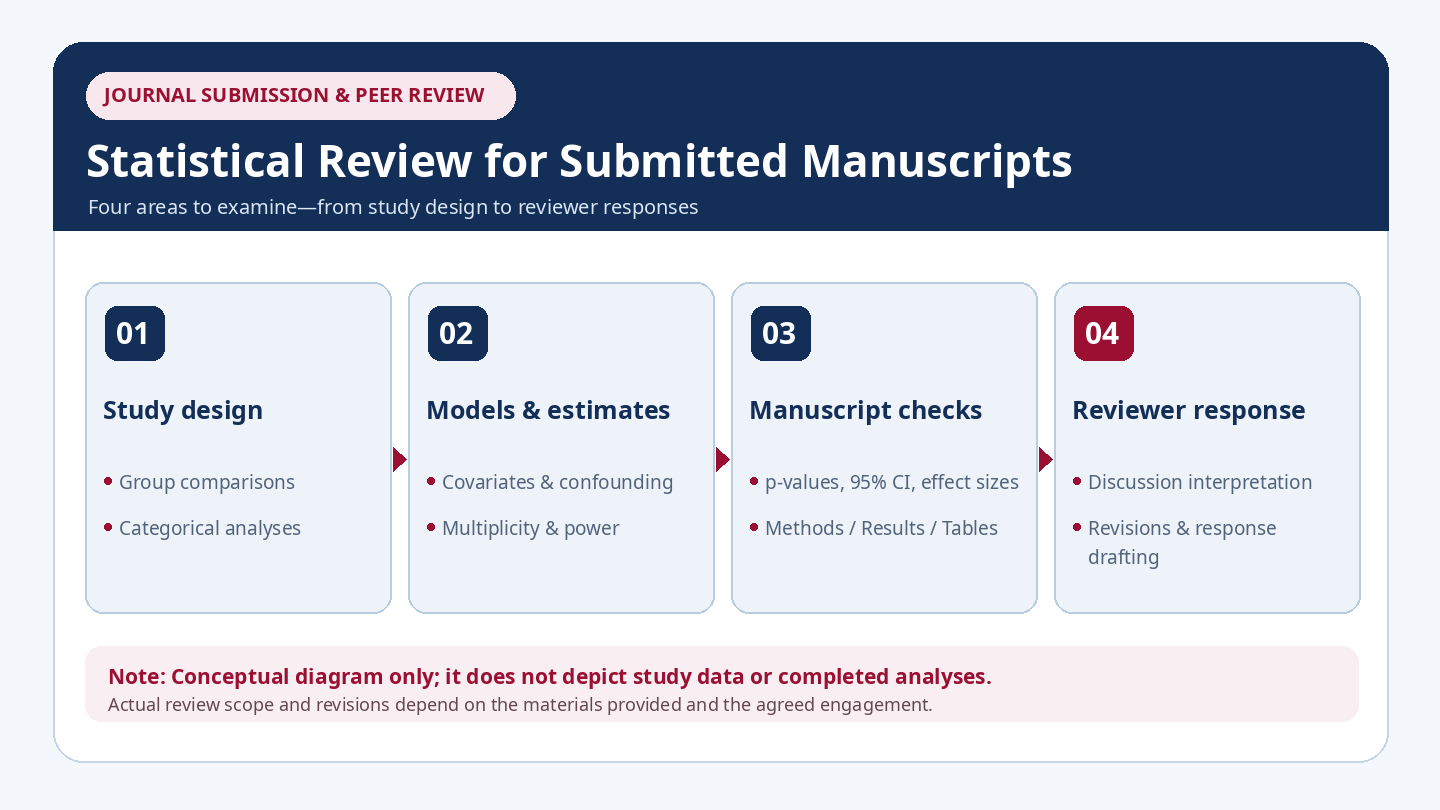
1. Campaign focus: submitted manuscripts, peer review and statistical second opinions
A statistical review is not limited to running additional statistical tests. It examines whether methods suit the research question, whether results are reported coherently, whether interpretations are justified and which issues reviewers may reasonably raise. The scope may be relevant while a manuscript is under review, before a revision or when preparing a response to reviewer comments.
The term “campaign” refers here to the promotion of this research-support service. No discount, fixed fee, deadline or turnaround time has been specified. Scope, price and schedule would be discussed individually after reviewing the available materials.
2. Twelve areas available for statistical review
| Domain | Review item | What is examined |
|---|---|---|
| Design and method selection | 1. Validity of study design and statistical approach | Alignment between research question, sampling, timing and analysis |
| 2. Appropriateness of statistical methods | Design, measurement scale, independence and distributional assumptions | |
| 3. Independent, paired and categorical-data comparisons | Whether tests and models reflect group and variable structure | |
| Models and estimation | 4. Multivariable models and covariate selection | Confounding, specification and overfitting concerns |
| 5. p-values, 95% confidence intervals and effect sizes | Accuracy, precision and consistency of estimates and reporting | |
| 6. Multiple testing, confounding, sample size and power | Design-specific concerns and the stated analysis plan | |
| Manuscript reporting | 7. Consistency of Methods, Results, Tables and Figures | Methods, sample sizes, numbers, labels and notes |
| 8. Statistical interpretation in Results and Discussion | Appropriate caution and distinction between association and causation | |
| 9. Potential reviewer or statistical-editor concerns | Points needing clarification or justification | |
| Revision support | 10. Specific suggestions for necessary revisions | Linking proposed revisions to an identified concern |
| 11. Statistical comments on the submitted manuscript | Comments tied to relevant manuscript sections | |
| 12. Response to Reviewer drafting support | Aligning reviewer questions with revisions, if needed |
Table 1 describes potential review activities based on the inquiry; it does not state that these checks have already been performed or that the manuscript has any identified flaw.
3. Checking that analytical methods fit the study
Independent samples, paired comparisons and categorical variables
Statistical choices depend on whether groups are independent or observations are repeated within participants. The measurement scale—continuous, ordinal or nominal—also affects which tests or models are suitable. A substantive review examines the actual study design and data structure before commenting on methods.
Multivariable analysis, covariates and estimation
For multivariable models, it is important to examine the rationale for covariates, potential confounding and the complexity of the model relative to the available sample. Conclusions should not rely on p-values alone: effect estimates, 95% confidence intervals and estimation precision may also be informative. Multiple testing and statistical power should be considered in the context of the study objectives and analysis plan, without retrospectively searching for convenient significant results.
4. Consistency across Methods, Results, Tables, Figures and Discussion
| Section | Points to cross-check | Consideration for revision |
|---|---|---|
| Methods | Eligibility, exclusions, variable definitions, methods and covariates | Describe the analyses actually performed |
| Results | Sample sizes, estimates, p-values and 95% confidence intervals | Match numbers in tables and separate findings from interpretation |
| Tables / Figures | Denominators, units, scales, legends and footnotes | Make analytical populations and numerical meaning clear |
| Discussion | Scope of conclusions, confounding, limitations and generalizability | Avoid unsupported causal statements |
| Reviewer response | Requested clarification, revised passages and possible added analyses | Align each response with an actual change to the manuscript |
5. Support for revisions and Responses to Reviewers
Reviewers may ask authors to explain their choice of tests or models, consider additional adjustments, report effect sizes or confidence intervals, or resolve discrepancies in statistical reporting. An effective response maps each reviewer concern to the corresponding manuscript change and supporting analytical evidence. Where appropriate, Stat Agent can discuss drafting statistical explanations or suggested text for a Response to Reviewer.
Any revised manuscript must accurately reflect work that was actually performed. We do not present unperformed analyses or unchecked estimates as verified results, and we do not guarantee editorial decisions or acceptance.
6. Consultation process and materials
A review may draw on the submitted draft (Methods, Results, Tables, Figures and Discussion), reviewer comments if available, prior statistical output, variable definitions and the analysis plan. Any sharing of potentially identifiable research data requires appropriate arrangements, including de-identification and agreement on the material to be transferred. The scope, deliverables, need for additional analyses, price and timeline would be determined after an initial review of the materials.
ImportantThis article reports no study-specific sample sizes, p-values, reviewer comments, statistical results or clinical findings. It explains the scope of potential statistical review services rather than identifying a problem in any particular study.
Frequently asked questions
- Q. Can a statistical review be requested after submission?
- Yes, you may inquire. The scope depends on the manuscript's review status, any reviewer comments and the revision deadline.
- Q. Does every manuscript need additional analysis?
- No. Existing analyses and reporting should be examined first. Additional analyses should be considered only where scientifically justified and feasible.
- Q. Can you help with English Responses to Reviewers?
- Where appropriate, consultation can include statistical explanations and suggested wording for a response. Authors remain responsible for final verification and submission.
Related topics
Journal manuscript review · Peer review response · Medical statistics · Independent and paired samples · Multivariable analysis · Covariates · Confounding · p-values · 95% confidence intervals · Effect size · Multiple testing · Statistical editing · Response to Reviewer
Published November 7, 2026. The university is identified solely on the basis of the inquiry described in the supplied material. Figure 1 is a conceptual illustration and does not present actual study data.
Related service 1: Statistical Analysis
Related service 2: Consulting and Advisory
Related service 3: Report and Document Preparation
Related service 4: Request a Quote / Contact Us
Contact Us
Over 30,000 consultations / Over 19,000 completed engagements. To date, we have supported consultations and requests involving analysis outsourcing, statistical processing, questionnaire surveys, marketing support, and more. Our experienced consultants carefully listen to your needs so that we can provide the right support. We offer prompt and accurate work at reasonable, accessible rates and are committed to delivering dependable results. Stat Agent team members across Japan will take responsibility for supporting you.
We provide the profile of the person responsible for your project when you apply.
For outsourced analysis and statistical processing, choose Stat Agent.
When order volume is high, it may be difficult to reach us by phone.
We apologize for the inconvenience. We respond in order of receipt, so if your matter is urgent, please contact us by
