
Pre-Submission Statistical Review for Medical Survey ResearchEvaluating existing results, data handling, analytical methods and manuscript reporting
Before submitting a research paper, it is important not only to consider additional analyses, but also to establish whether the existing results adequately address the research objectives.
Stat Agent received an inquiry from a university researcher about statistical analysis of questionnaire data concerning a health condition and a review before journal submission. The inquiry concerned how to assess existing statistical results, data handling practices and analytical choices in the context of a manuscript already under preparation.
For this kind of request, the appropriate scope goes beyond descriptive tabulations or running further analyses. It may require reviewing the alignment among research questions, data structure, statistical assumptions, interpretation and presentation in the manuscript.
ConfidentialityThis article summarizes general review considerations derived from the inquiry. It does not identify the university, researcher, health condition, participant characteristics, questionnaire items, underlying data, sample size or statistical findings. It does not claim that the review has been completed or that a manuscript has been submitted or accepted.
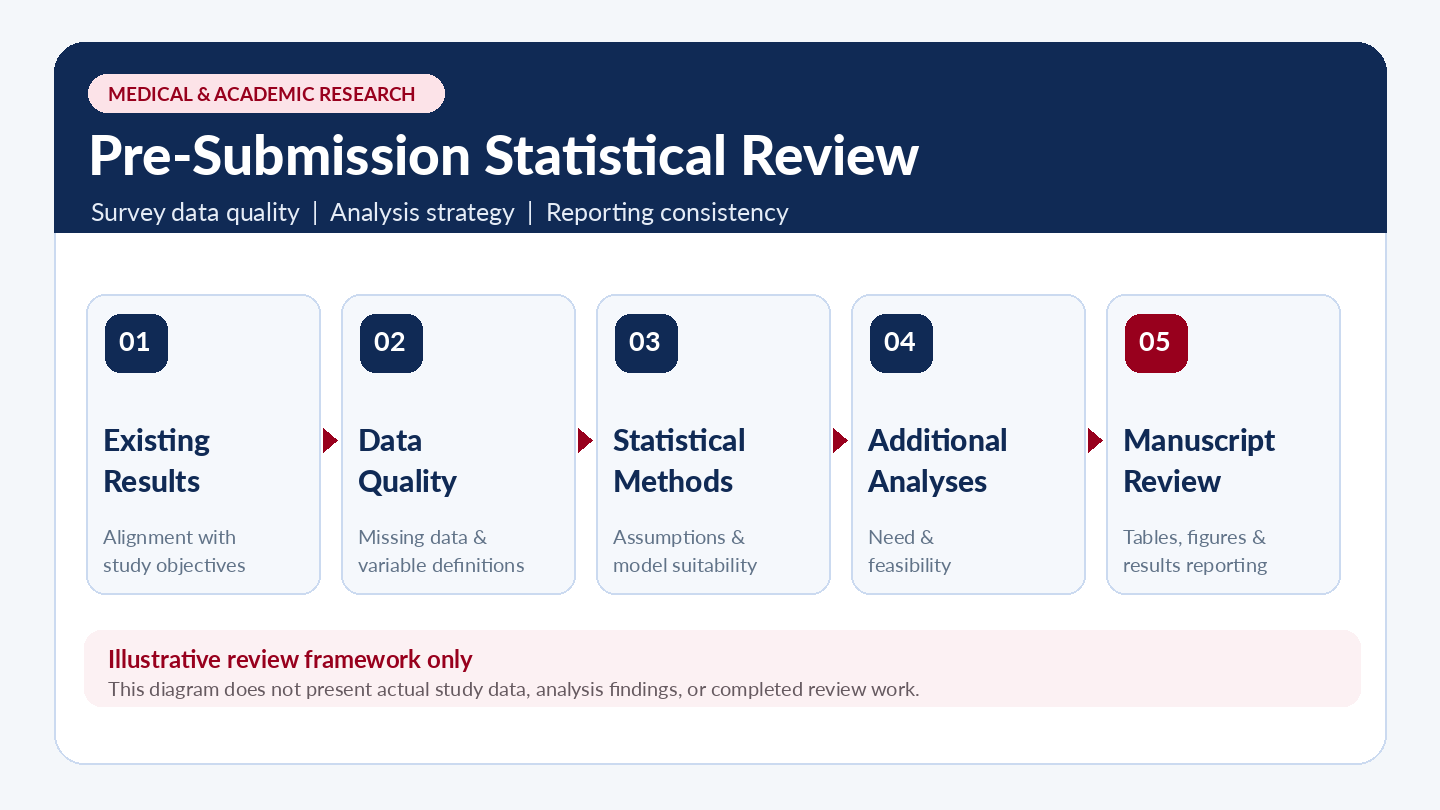
1. What is a pre-submission statistical review?
A statistical review is more than checking numerical calculations. It considers whether the datasets and variables are appropriate for the research question, whether the chosen methods are reasonable, and what conclusions are supported by the results. It may also examine consistency between the manuscript and its tables, including sample sizes, variable names, statistical estimates and reported tests.
The inquiry suggested five potential review areas: (1) validity and consistency of existing results, (2) data handling, (3) analytical strategy and statistical methods, (4) the need for additional variables or analyses, and (5) tables, figures and written results for journal submission. These describe a possible review scope; they do not indicate that any deficiencies were identified or that reanalysis has been judged necessary.
| Review area | Items to examine | Purpose |
|---|---|---|
| Existing results | Alignment with research aims, analysis sample size, reported statistics, p-values and confidence intervals | Assess whether results address the research questions clearly and appropriately |
| Data handling | Variable definitions, levels of measurement, missing values, exclusions, categorization, reverse-coded items and recoding | Reduce the risk of misinterpretation arising from unintended transformations or inconsistent samples |
| Analytical methods | Outcome characteristics, study design, independence, distributions, statistical assumptions and confounding | Assess the fit between the methods, data structure and research objectives |
| Additional analyses | Potential covariates, sensitivity analyses, effect sizes, missing-data strategies and alignment with the analysis plan | Determine whether further analyses are warranted and feasible |
| Manuscript reporting | Agreement among text, tables and figures; denominators; estimates and uncertainty; appropriately bounded interpretations | Support transparent, traceable reporting and communication of limitations |
2. Checking existing statistical results and questionnaire data
Alignment between results and research aims
The starting point is to establish how each analysis addresses the stated objectives or hypotheses. Describing response distributions, comparing groups and estimating associations between variables answer different types of questions and support different conclusions. Before increasing the number of analyses, it is useful to clarify which results address the primary research question.
Missing data, coding and analysis populations
Questionnaire datasets need careful handling of unanswered items, non-applicable responses and other missing values. These categories should not be inadvertently treated as equivalent. Scoring direction, respondent identifiers, reverse-coded items and any changes in variable definitions should be checked. Where exclusions or missing values lead to different sample sizes across analyses, recording the reason and denominator supports reproducible reporting.
3. Selecting statistical methods according to the data
Method selection depends on the study aim, outcome measurement scale, independence of observations, sample size, missing-data patterns and other design features. Models for continuous outcomes, binary outcomes and ordered responses have different assumptions and interpretation requirements. Repeated measurements or clustered observations may also require methods that account for their dependence.
Adding more explanatory variables does not necessarily improve a model. Covariates should be considered in light of scientific relevance, their plausibility as confounding variables, the information available in the dataset, estimation stability and overfitting risk. Statistical methods should be selected after examining the research design and data structure, rather than imposed in advance.
ImportantThe considerations described here are general. The underlying questionnaire responses and statistical outputs have not been evaluated for the purpose of this article. No conclusion is being offered on a particular method, statistical significance or the need for additional analysis.
4. Determining the need for additional analyses or variables
A pre-submission review can help establish whether further analyses would contribute meaningfully to the paper. Where only unadjusted estimates are presented, it may be appropriate to consider adjustment variables justified by the hypothesis and design. Conversely, adding parameters to a small dataset can make estimates unstable.
Any proposed analysis should have an explicit purpose: what question would it answer, and how would it complement the results already available? If additional data collection is not feasible, clearly separating conclusions supported by the available data from unresolved questions and study limitations can still strengthen the manuscript's reporting.
5. Ensuring consistency across manuscript text, tables and figures
Even when methods are appropriate, inconsistent reporting can obstruct accurate interpretation. Before submission, it is useful to check participant flow, analysis-specific sample sizes, group definitions, estimates, units, effect directions, confidence intervals and accompanying notes across the manuscript.
| Manuscript component | Review focus | Potential concern |
|---|---|---|
| Methods / statistical analysis | Variables, eligible observations, methods, missing-data handling and prespecified decision rules | Whether the description matches what was actually done |
| Results narrative | Principal comparisons and associations, direction of effects, statistics and uncertainty | Whether text includes unsupported numbers or stronger conclusions than results justify |
| Tables | Variable labels, units, denominators, summary statistics and explanatory notes | Whether measurement scales and reporting conventions are consistent |
| Figures | Axes, legends, groups, error displays and figure notes | Whether visual emphasis overstates the available evidence |
| Discussion / limitations | Design, confounding, selection bias, missing data and generalizability | Whether observed associations are improperly presented as causal effects |
6. A practical approach to review for medical and university research
In an actual engagement, the review scope would depend on the materials that can be shared, such as the research aims, draft manuscript, data dictionary, de-identified analysis dataset and existing statistical outputs. An initial review can identify questions requiring clarification and potential revisions. Further tabulation, reanalysis or changes to tables and figures would be considered only when justified by the findings of that review. Whether reanalysis is necessary is itself a question to be assessed.
Stat Agent considers inquiries concerning medical statistics, questionnaire data analysis, pre-submission statistical review, statistical consulting and the consistency of research tables and graphs, with the scope determined according to the specific request.
Frequently asked questions
- Q. Does a pre-submission review always require a complete reanalysis?
- No. Existing data processing, model specifications, outputs and manuscript descriptions can be checked first. The need for reanalysis depends on any issues identified and the questions that remain unresolved.
- Q. Are additional variables or analyses always necessary for questionnaire research?
- No. The need for, and feasibility of, additional analyses depend on the research objectives, analysis plan, collected data and sample size. There should also be a clear rationale when further analysis is not warranted.
- Q. Can tables and figures be reviewed without redoing the entire analysis?
- You can inquire about a focused review. However, assessing the accuracy of numerical values or figure content may still require cross-checking statistical outputs, source data or variable definitions.
Scope of this articleThe original inquiry concerned checks prior to journal submission for a specific health-related questionnaire study. This article explains general review principles; it does not publish study-specific findings, completed statistical validation, or a finished client engagement.
Related topics
Pre-submission statistical review · Medical statistics · Questionnaire analysis · Data cleaning · Missing data · Statistical consulting · Sensitivity analysis · Manuscript tables and figures · Research support
Published October 17, 2026. This article anonymizes the subject of an inquiry and describes general review considerations. It does not infer unreported study sample sizes, statistical tests, results, clinical effects or journal decisions. Figure 1 is explanatory only.
Related service 1: Statistical Analysis
Related service 2: Consulting and Advisory
Related service 3: Data Tabulation and Charting
Related service 4: Report and Document Preparation
Related service 5: Request a Quote / Contact Us
Contact Us
Over 30,000 consultations / Over 19,000 completed engagements. To date, we have supported consultations and requests involving analysis outsourcing, statistical processing, questionnaire surveys, marketing support, and more. Our experienced consultants carefully listen to your needs so that we can provide the right support. We offer prompt and accurate work at reasonable, accessible rates and are committed to delivering dependable results. Stat Agent team members across Japan will take responsibility for supporting you.
We provide the profile of the person responsible for your project when you apply.
For outsourced analysis and statistical processing, choose Stat Agent.
When order volume is high, it may be difficult to reach us by phone.
We apologize for the inconvenience. We respond in order of receipt, so if your matter is urgent, please contact us by
