
Statistical Analysis Support for Psychological Research at Ritsumeikan UniversityOverview of Support for Multiple Regression and Structural Equation Modeling Related to Psychological Stress and Other Factors
Supporting Hypothesis Testing in Psychological Research through Appropriate Statistical Analysis and Clear Organization of Results
Stat Agent providedstatistical analysis supportfor psychological research at Ritsumeikan University. This article introduces an overview of support involvingmultiple regression analysis, structural equation modeling, and related methodsin research addressing psychological stress and related constructs.
In consideration of research ethics and confidentiality, this page does not disclose information about research participants, specific measures, analytical results, or unpublished research content. Instead, it focuses on the general flow of statistical support in psychological research and the analytical considerations emphasized in the project.
Support OverviewFor research involving multiple psychological scales and associated factors related to psychological stress and similar constructs, we supported organization of the analytical strategy according to the research objectives and hypotheses, multiple regression analysis, structural equation modeling, review of results, and preparation of wording suitable for manuscripts and reports.
Importance of Statistical Analysis in Psychological Research
Research DesignPsychological research often treats constructs that are difficult to observe directly—such as psychological stress, emotions, cognition, behavior, interpersonal relationships, and living environment—as scale scores. It is therefore necessary to organize the research objectives, hypotheses, roles of variables, and scale structure before selecting appropriate analytical methods.
Rather than merely entering data into statistical software, it is important to examine relationships between outcome and explanatory variables, factors that should be controlled, correlations among variables, handling of missing values, and validity of the analytical model in order to obtain interpretable results.
Examining Associated Factors through Multiple Regression Analysis
Multiple Regression AnalysisMultiple regression analysis is a method for examining simultaneously how several explanatory variables are related to an outcome variable. When psychological stress or a similar construct is used as the outcome, the method can assess which variables are independently associated with the outcome while adjusting for the effects of the other variables.
In our analytical support, we organized key checks needed for appropriate interpretation, including variable selection based on research hypotheses, examination of strong correlations among explanatory variables, interpretation of regression coefficients and coefficients of determination, and consideration of residuals and outliers. It is important to describe not only statistical significance but also the direction and magnitude of coefficients and their substantive meaning in the research context.
| Item to Check | Main content | Key Points in Our Support |
|---|---|---|
| Variable Specification | Roles of outcome variables, explanatory variables, and control variables | Clarify the analytical model in accordance with the research objectives and hypotheses. |
| Multicollinearity | Strong correlations among explanatory variables | Check correlation coefficients, VIF, and related indicators, and be alert to instability in coefficient estimates. |
| Model Evaluation | Coefficient of determination, adjusted coefficient of determination, and overall model test | Assess how well the model explains the outcome variable. |
| Interpretation of Coefficients | Partial regression coefficients, standardized coefficients, p-values, and confidence intervals | Organize the direction and magnitude of associations together with their substantive meaning in the research context. |
| Checking Assumptions | Linearity, homoscedasticity, residual distribution, and influential observations | Examine whether any issues could compromise the validity of the analytical results. |
Examining Theoretical Models through Structural Equation Modeling
structural equation modelingStructural equation modeling is an analytical method for simultaneously examining hypothesized relationships among multiple variables within a theoretical model. Also known as SEM, it is used in psychological research to examine path models that assume directional relationships among observed variables and models that include latent variables measured by multiple questionnaire items.
In our support, we checked consistency between the research hypotheses and model diagram, specification of individual paths, model identification, estimation results, goodness-of-fit indices, and interpretation of direct and indirect effects. It is important not to judge a model solely by goodness-of-fit indices, but to evaluate it using both theoretical rationale and statistical results.
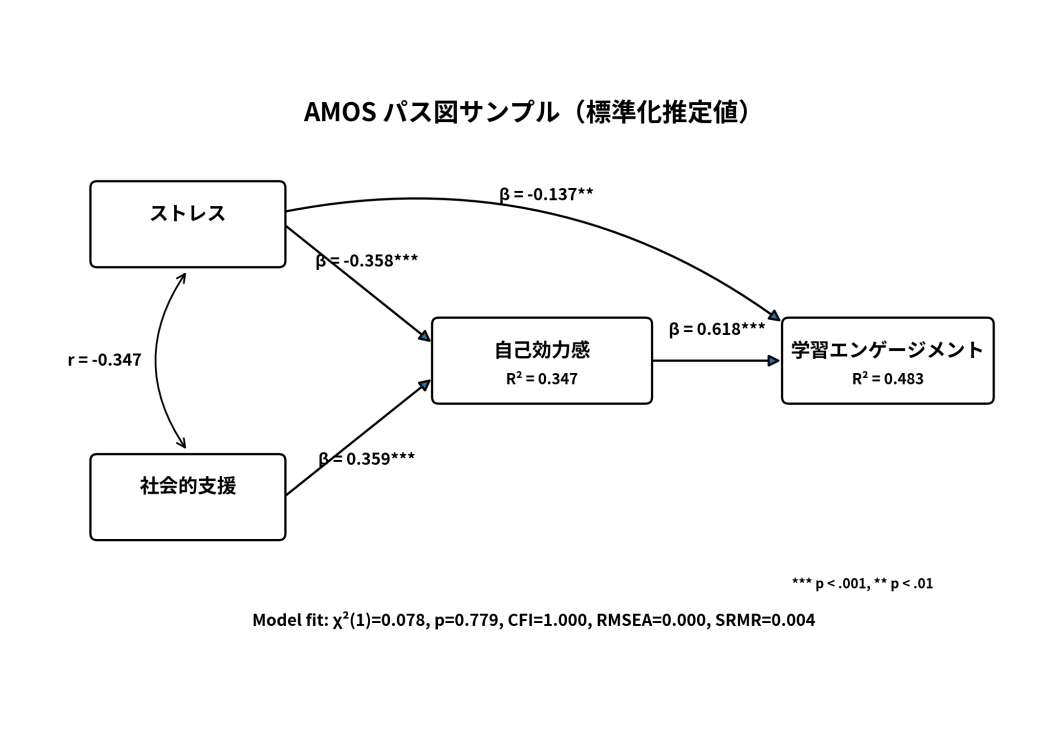
| Support Area | Specific Items to Check | Examples of Deliverables and Organized Outputs |
|---|---|---|
| Model Design | Research hypotheses, relationships among variables, direction of paths, and specification of error terms | Analytical model, path diagram, and correspondence table between hypotheses and paths |
| Estimation Results | Unstandardized estimates, standardized estimates, standard errors, and p-values | Estimation-results table and interpretation of major paths |
| Model Fit | Multiple fit indices and overall validity of the model | List of fit indices and draft wording for results |
| Organization of Effects | Direct effects, indirect effects, and total effects | Effect-decomposition table and explanation of mediation relationships |
| Visualization of Results | Display of path coefficients, significant relationships, and explained variance | Path diagrams for papers and presentations, with figure and table notes |
Key Points When Incorporating Analytical Results into Papers and Reports
Results ReportingIn statistical analysis for psychological research, results should not merely be presented as numbers; they need to be described in a way that directly addresses the research objectives. The Methods section should clearly state the analytical methods, variable specifications, estimation procedures, and decision criteria, while the Results section should present major coefficients, goodness-of-fit indices, explained variance, and related information in an appropriate level of detail.
In the Discussion, statistically identified associations should be interpreted in relation to theory and prior research, while limitations of the study design must also be acknowledged—for example, avoiding causal claims based on cross-sectional research. Stat Agent supports not only preparation of analytical tables but also interpretation of findings and organization of manuscript wording according to the research objectives.
Psychological Statistics Support Using SPSS, AMOS, and Related Software
Analytical EnvironmentIn psychological research, SPSS may be used for descriptive statistics, correlation analysis, and multiple regression, while AMOS may be used for structural equation modeling and path analysis. What matters is not merely operating the software, but specifying a model appropriate to the research objectives and interpreting the output accurately.
We provide support tailored to the stage of the research, including data review, organization of the analytical strategy, statistical analysis, formatting of output tables, creation of path diagrams, and narrative reporting of research findings. The analytical methods and software actually used are determined after reviewing the research objectives, data structure, measurement levels, sample size, and related considerations.
SummaryIn our support for psychological research at Ritsumeikan University, we assisted with statistical analyses including multiple regression and structural equation modeling for research addressing psychological stress and related constructs. In psychological research, it is important to ensure consistency between hypotheses and analytical models, check assumptions, interpret coefficients and model fit appropriately, and report results accurately in manuscripts.
Stat Agent's Support for Psychological Research and Statistical Analysis
Stat Agent supports research in psychology, education, medicine and nursing, social sciences, and related fields through statistical analysis, data organization, analysis planning, SPSS and AMOS analysis, structural equation modeling, path-diagram creation, reporting of results in papers and reports, and preparation of materials for peer-review responses.
If you are unsure how to apply multiple regression or structural equation modeling to your research, or need help interpreting and writing up analytical results, we review your research objectives and data situation and propose the support required.
Related Keywords
#RitsumeikanUniversity #PsychologicalResearch #StatisticalAnalysisSupport #PsychologicalStress #MultipleRegression #StructuralEquationModeling #SEM #PathAnalysis #SPSS #AMOS #MultivariateAnalysis #ManuscriptSupport #ResearchSupport #StatAgent
Publication policy: This article was prepared based on a support overview provided by the client that may be made public. It does not disclose research participants, specific measurement items, analytical values, unpublished research findings, or personally identifiable information.
Related Information 1:Statistical Analysis
Related Information 2:Consulting & Advisory
Related Information 3:Tabulation & Charting
Related Information 4:Report & Document Preparation
Related Information 5:Quotations / Contact
Contact Us
Over 30,000 consultations / Over 19,000 completed engagements. To date, we have supported consultations and requests involving analysis outsourcing, statistical processing, questionnaire surveys, marketing support, and more. Our experienced consultants carefully listen to your needs so that we can provide the right support. We offer prompt and accurate work at reasonable, accessible rates and are committed to delivering dependable results. Stat Agent team members across Japan will take responsibility for supporting you.
*We provide the profile of the person responsible for your project when you apply.
For outsourced analysis and statistical processing, choose Stat Agent.
*When order volume is high, it may be difficult to reach us by phone.
We apologize for the inconvenience. We respond in order of receipt, so if your matter is urgent, please contact us by
