
Recommended Statistics BooksRecommended Statistics Books
Major Types of Recommended Statistics Books
One of the first questions people face when they want to study statistics is which book to read first. Statistics books vary widely: some are systematic textbooks, some are written gently for beginners without a strong mathematical background, some cover analytical methods used in practice, and others focus on why statistical thinking matters. It is therefore important to choose a book not simply because it is famous, butaccording to why you want to learn statistics.Here we introduce four real Japanese-language statistics books selected for readers ranging from beginners to those who want to use statistics in practice.Recommended Statistics Books
Recommended statistics books can be divided into several representative types depending on learning style and target reader. Each is introduced below.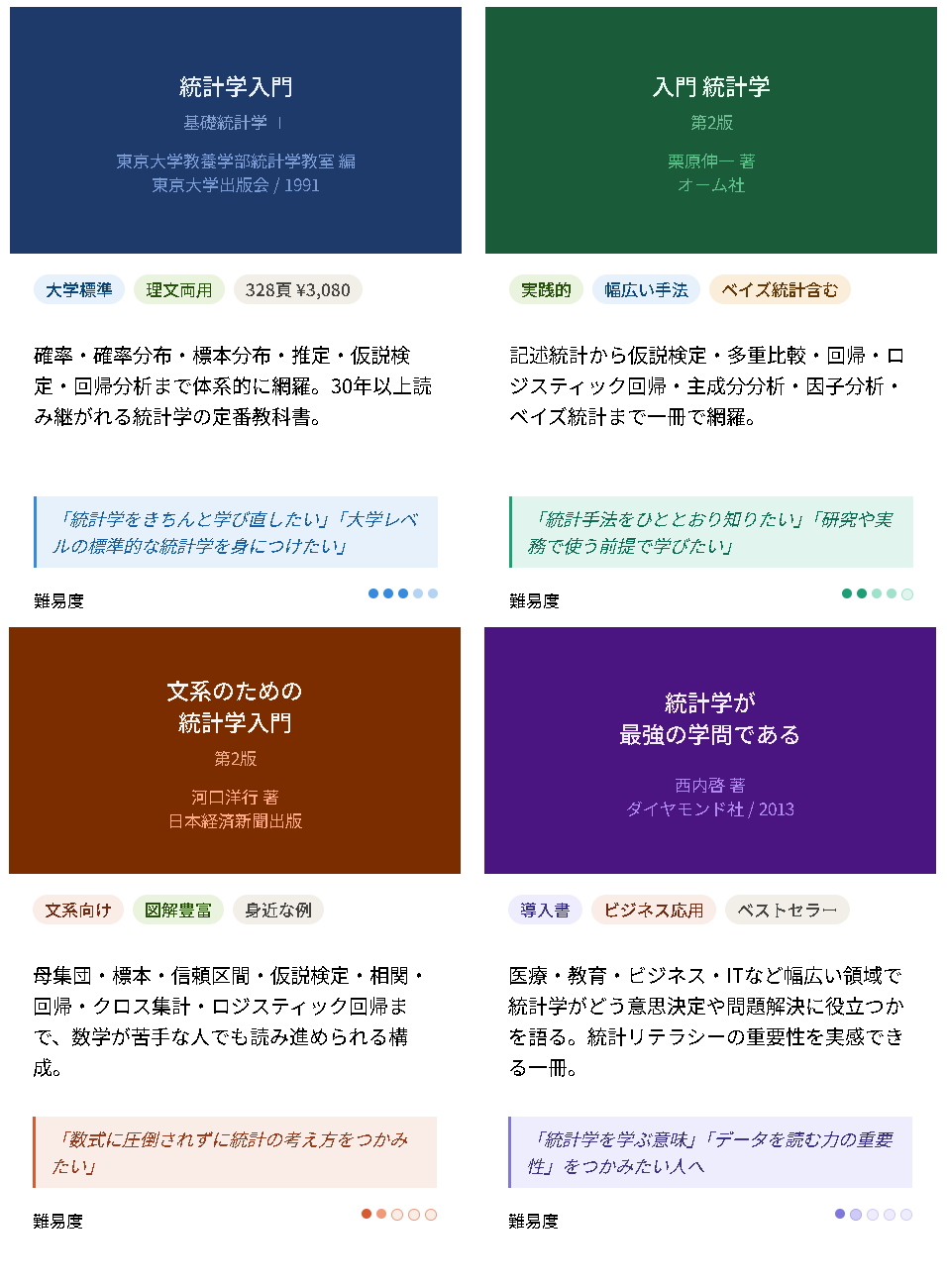
1. “Introduction to Statistics” (edited by the Statistics Department, College of Arts and Sciences, The University of Tokyo):
“Introduction to Statistics” is a well-regarded book for systematically learning the foundations of statistics. It covers probability, probability distributions, sampling distributions, estimation, hypothesis testing, and regression in a textbook-style sequence and is suited to people whowant to relearn statistics properly or acquire standard university-level statistical foundations.It is somewhat textbook-like rather than extremely easy reading, but its long-standing use makes it a strong choice for readers who want to build a solid foundation from the ground up.
2. “Introductory Statistics, 2nd Edition” by Shinichi Kurihara:
This practical introductory book broadly covers descriptive statistics, hypothesis testing, multiple comparisons, regression, logistic regression, principal component analysis, factor analysis, and Bayesian statistics in one volume. Because it explains not only formulas but also how to think about and use analytical methods,it is suited to readers who want an overview of statistical methods or plan to use them in research or practice.It is useful for grasping the overall landscape of statistics.
3. “Introduction to Statistics for Humanities and Social Science Students, 2nd Edition” by Hiroyuki Kawaguchi:
This introductory book uses familiar examples and many figures so that readers who are not comfortable with mathematics can follow the material. It explains populations and samples, confidence intervals, hypothesis testing, correlation, regression, cross-tabulation, and logistic regression in a context accessible to non-STEM readers. It is especially suitable for students and working adults learning statistics for the first time whowant to understand statistical thinking without being overwhelmed by formulas.
4. “Statistics Is the Most Powerful Academic Discipline” by Hiroshi Nishiuchi:
Rather than a rigorous textbook, this book is an excellent introduction to why statistics matters in modern society. It discusses how statistics supports decision-making and problem-solving across medicine, education, business, IT, and other fields, making the importance of statistical literacy easy to appreciate. It is suited to readers who want to understandwhy statistics is worth learning and why the ability to read data mattersmore than learning detailed calculations first.
The best statistics book depends on whether you want something gentle, textbook-like, or directly useful for research. An accessible humanities-oriented or general-education book can be a strong first choice, while readers planning for undergraduate theses, master's theses, academic papers, or practical analysis will benefit from moving relatively early to a standard statistics textbook or practical introductory book. It is also very important toapply what you read to your own data or familiar examples rather than stopping at passive reading.
“Introduction to Statistics” (edited by the Statistics Department, College of Arts and Sciences, The University of Tokyo)
“Introduction to Statistics” is a standard book for systematically learning statistics. It is often used as a university textbook and is suited to people who want to understand the foundations of statistics in sequence, from probability through estimation, hypothesis testing, and regression. It is not a light read, but it is highly valuable for readers who want a strong foundation.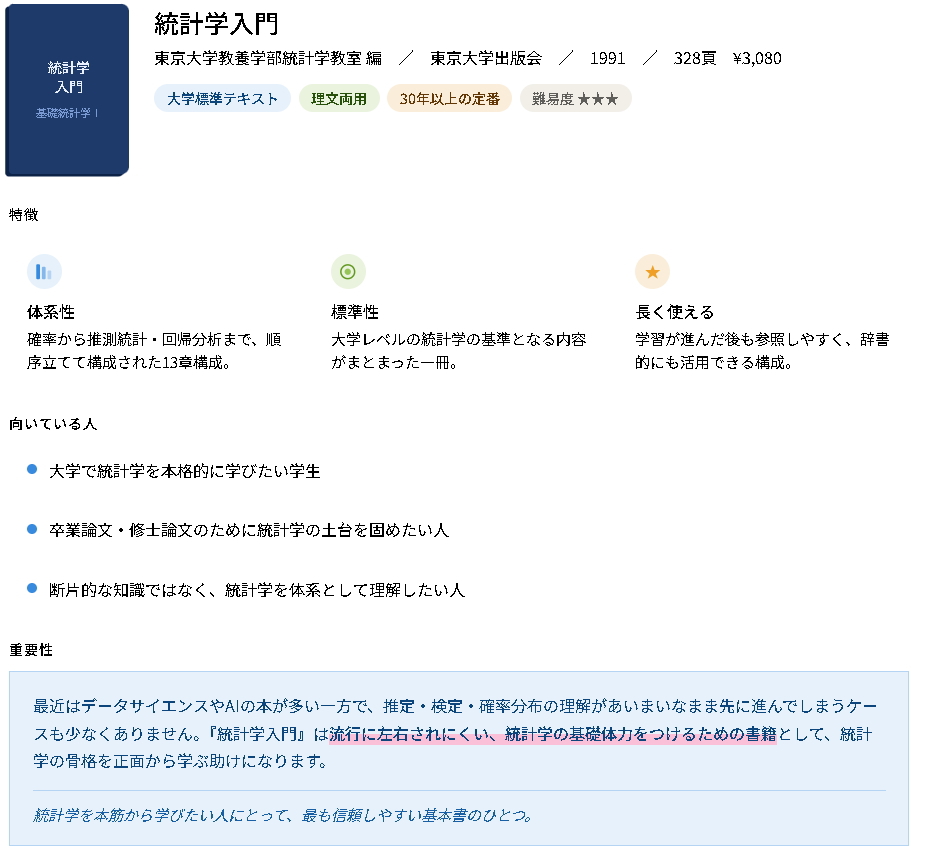
Characteristics of “Introduction to Statistics”
Systematic: Learn statistical foundations in sequence from probability through inferential statistics and regression.
Standard: Covers content that serves as a benchmark for university-level statistics.
Useful over the long term: Structured to remain a useful reference as learning progresses.
Who “Introduction to Statistics” Is For
University students who want to study statistics seriously.
People who want to build statistical foundations for an undergraduate or master's thesis.
Readers who want to understand statistics as a coherent discipline rather than as fragmented methods.
Importance of “Introduction to Statistics”
“Introduction to Statistics” is important asa book for building durable statistical foundations that are not easily affected by trends.Although many recent books focus on data science and AI, people sometimes move ahead without fully understanding foundational estimation, hypothesis testing, or probability distributions. This book helps learners engage directly with the core structure of statistics.
Thus, “Introduction to Statistics” is one of the most dependable foundational texts for readers who want to study statistics from first principles.
“Introductory Statistics, 2nd Edition” by Shinichi Kurihara
This practical introductory book is suitable for readers who want broad coverage in one volume. It covers inferential statistics, hypothesis testing, multiple comparisons, regression, multivariate analysis, and Bayesian statistics and is structured to connect learning directly to actual analysis. Its strength is that it explains not only theory but also the role and way of thinking behind analytical methods.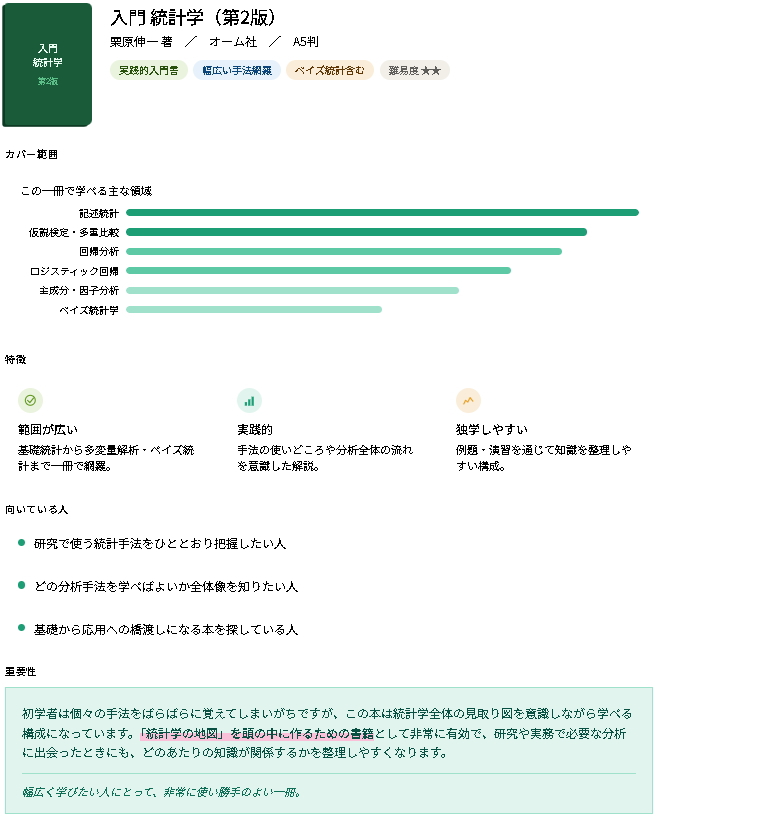
Characteristics of “Introductory Statistics, 2nd Edition”
Broad scope: Covers material from basic statistics through multivariate analysis and Bayesian statistics.
Practical: Makes it easier to understand when methods are used and how the overall analytical process fits together.
Suitable for self-study: Examples and exercises help organize knowledge.
Who “Introductory Statistics, 2nd Edition” Is For
Readers who want a broad overview of statistical methods used in research.
Readers who want to understand the overall landscape before deciding which methods to study in depth.
Readers looking for a bridge from foundations to applied methods.
Importance of “Introductory Statistics, 2nd Edition”
This book is highly effective asa guide for building a mental map of statistics.Beginners often memorize methods in isolation, but this book is structured to help learners understand how the field fits together. This makes it easier to identify which areas of knowledge are relevant when a particular analysis is needed in research or practice.
Thus, “Introductory Statistics, 2nd Edition” is a highly practical volume for readers who want broad coverage.
“Introduction to Statistics for Humanities and Social Science Students, 2nd Edition” by Hiroyuki Kawaguchi
This introductory book is highly accessible even for readers who feel uneasy about formula-heavy explanations. Rather than relying only on abstract definitions, it explains statistical thinking using familiar examples such as typhoon forecast circles, health foods, advertising expenditure, and questionnaires, making the subject more approachable for people who are not comfortable with statistics.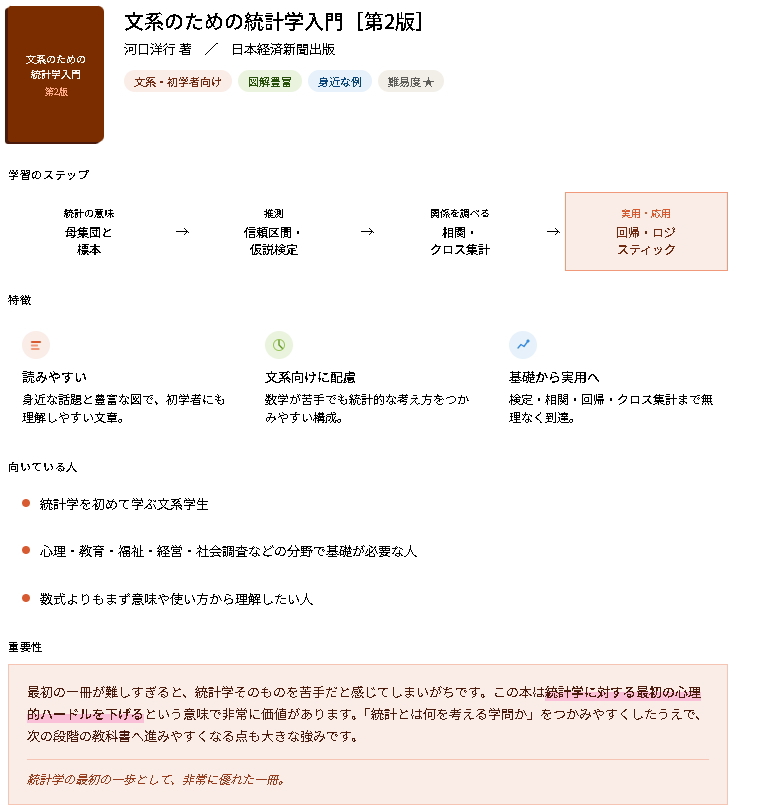
Characteristics of “Introduction to Statistics for Humanities and Social Science Students, 2nd Edition”
Readable: Uses familiar topics and many figures, making it accessible for beginners.
Designed for non-STEM readers: Helps readers without strong mathematical backgrounds grasp statistical ways of thinking.
Connects foundations to practical methods: Covers testing, correlation, regression, and cross-tabulation in a manageable progression.
Who This Book Is For
Humanities and social-science students learning statistics for the first time.
Readers in psychology, education, welfare, management, social research, and related fields who need statistical foundations.
Readers who want to understand meaning and use before focusing heavily on formulas.
Importance of This Book
This book is highly effective asIt has considerable value in lowering the initial psychological barrier to statistics.If a first book is too difficult, beginners can come to believe that statistics itself is beyond them. This book makes it easier to understand what statistics is trying to accomplish and provides a natural path to more advanced textbooks when needed.
Thus, it is an excellent first step into statistics.
“Statistics Is the Most Powerful Academic Discipline” by Hiroshi Nishiuchi
This book focuses less on detailed calculation and more on why statistics matters in modern society. It clearly shows how statistics influences medicine, education, business, IT, policy, and many other fields, making the need for statistical literacy easy to appreciate.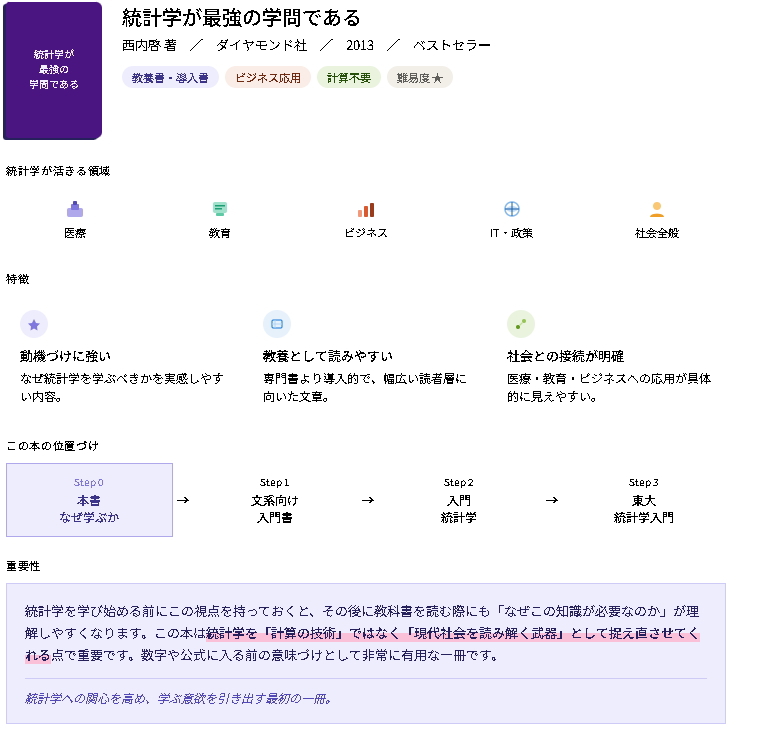
Characteristics of “Statistics Is the Most Powerful Academic Discipline”
Strong motivation: Helps readers understand why learning statistics is worthwhile.
Accessible as general reading: More introductory than a specialist textbook and suitable for a broad audience.
Clear connection to society: Applications to medicine, education, business, and other areas are easy to see.
Who This Book Is For
Readers who want to understand the purpose of learning statistics first.
Working adults who want to improve data literacy.
Readers looking for an introductory book before moving to a rigorous textbook.
Importance of This Book
This book is highly effective asIt is valuable for reframing statistics not merely as a calculation technique but as a tool for understanding modern society.Having that perspective before beginning formal study can make it easier to understand why specific concepts are needed later. It provides useful motivation before engaging with formulas and technical details.
Thus, the book can be recommended for increasing interest in statistics and encouraging further study.
