
Practical Examples of Medical StatisticsMedical Statistics Example
Major Practical Examples of Medical Statistics
This section explains practical examples of medical statistics. Medical statistics refers tostatistical methods used to organize and analyze clinical-care data, clinical-research data, nursing-research data, epidemiological data, and related information in order to clarify treatment effects, prognosis, risk factors, and differences in patient characteristics.In medical settings, simply collecting numbers is not sufficient. Researchers must examine whether differences and associations could be due to chance, which factors are clinically important, and how outcomes change over time. Medical statistics are therefore used in a broad range of settings, including clinical trials, observational studies, retrospective studies, prospective cohort studies, medical-record reviews, QOL evaluation, and adverse-event assessment.Practical Examples of Medical Statistics
Representative analytical situations differ according to the research objective and nature of the outcome. Examples are explained below.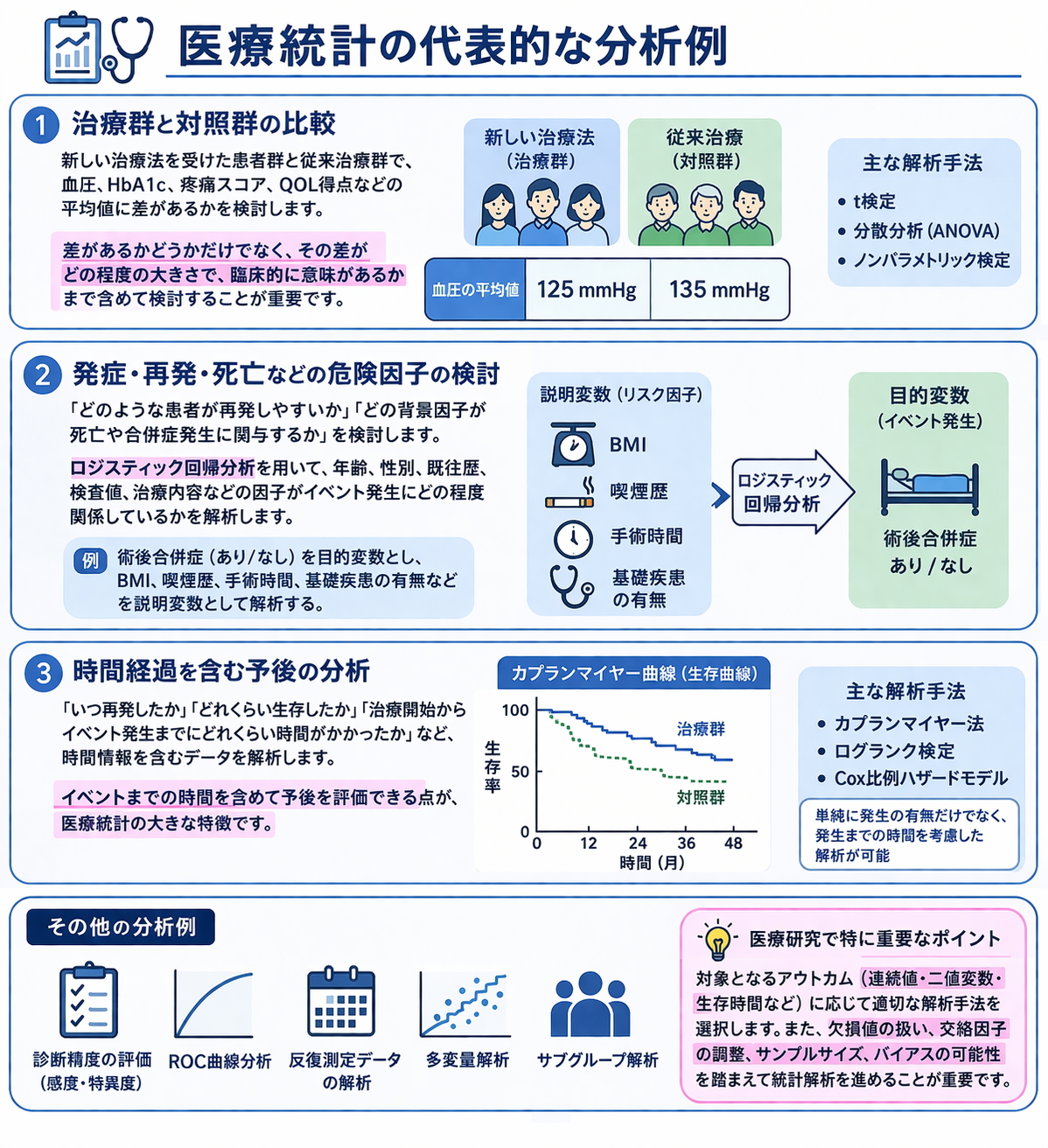
1. Comparison of Treatment and Control Groups:
One of the most basic examples in medical statistics is a comparison between a treatment and control group, or before and after an intervention. For example, researchers may examine whether mean blood pressure, HbA1c, pain scores, or QOL scores differ between patients receiving a new treatment and those receiving conventional care. t-tests, ANOVA, or nonparametric tests may be used depending on the data. The important point is to considernot only whether a difference exists, but also its magnitude and whether it is clinically meaningful.
2. Examination of Risk Factors for Onset, Recurrence, Death, or Other Events:
Medical research frequently asks questions such as which patients are more likely to experience recurrence or which background factors are associated with death or complications. Logistic regression can be used to examine how factors such as age, sex, medical history, laboratory values, and treatment relate to event occurrence. A typical example is using postoperative complication status as the outcome and BMI, smoking history, operation time, and comorbidities as explanatory variables.
3. Prognostic Analysis Incorporating Time:
In medical statistics, time information—such as when recurrence occurred, how long a patient survived, or how long it took for an event to occur after treatment began—may be crucial. Survival analysis is used in such settings, including Kaplan–Meier methods, log-rank tests, and Cox proportional-hazards models. Rather than examining only whether an event occurred,these methods allow prognosis to be evaluated while incorporating time to the event,which is a major feature of medical statistical analysis.
Other medical-statistical analyses include assessment of diagnostic accuracy, sensitivity and specificity, ROC-curve analysis, repeated-measures analysis, multivariable analysis, and subgroup analysis. The appropriate method depends on whether the outcome is continuous, binary, or time-to-event. In medical research, it is especially important to conduct analysis while consideringmissing-data handling, adjustment for confounders, sample size, and potential bias.
Comparison of Treatment and Control Groups
Comparing treatment and control groups is one of the most basic and clinically relevant examples in medical statistics. It is used to determine whether patient outcomes differ according to new versus existing treatments, presence or absence of an intervention, differences in nursing care, and similar conditions. Continuous outcomes may be compared with t-tests or ANOVA, while markedly skewed distributions may call for methods such as the Mann–Whitney U test.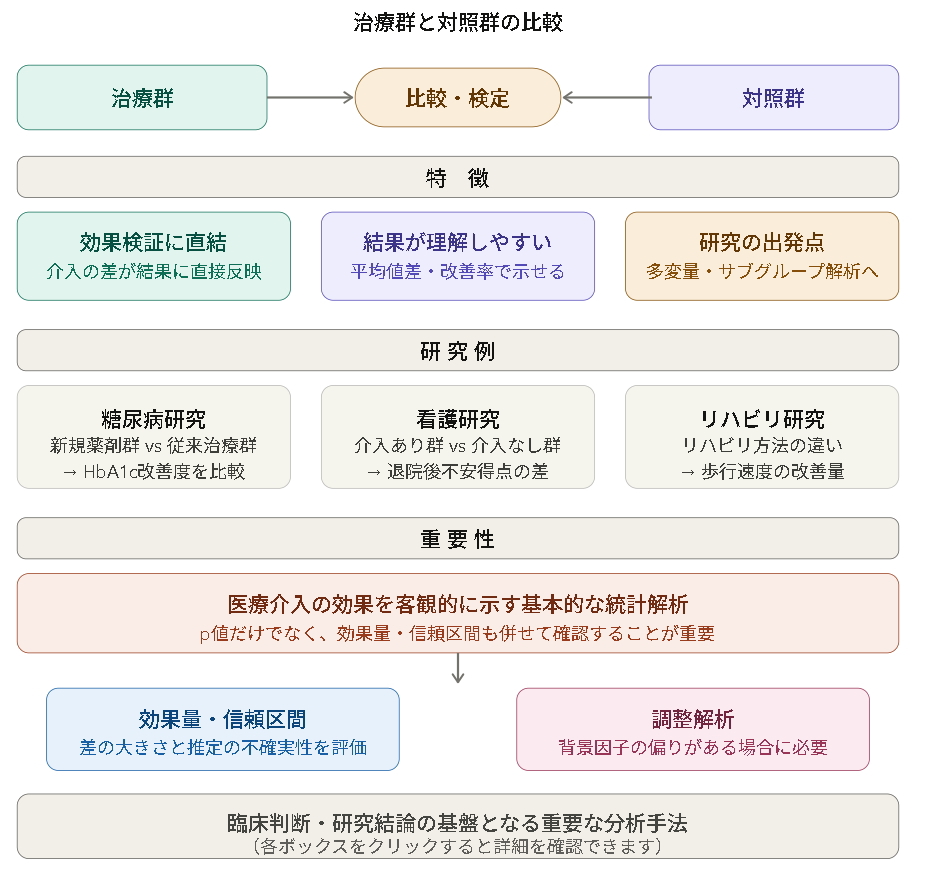
Characteristics of Treatment–Control Comparisons
Direct assessment of effectiveness: Differences in interventions or treatments can be examined directly in relation to outcomes.
Easy-to-understand results: Mean differences, median differences, improvement rates, and related measures can often be presented in forms that are readily interpretable in clinical settings.
Useful starting point for research: Between-group comparisons often provide a foundation for subsequent multivariable or subgroup analyses.
Examples of Treatment–Control Comparisons
Diabetes research: Compare improvement in HbA1c between a new-drug group and a conventional-treatment group.
Nursing research: Compare post-discharge anxiety scores between intervention and non-intervention groups.
Rehabilitation research: Compare improvement in walking speed between different rehabilitation methods.
Importance of Treatment–Control Comparisons
Treatment–control comparison isa fundamental statistical analysis for objectively demonstrating the effect of a medical intervention.However, interpretation should not rely only on p-values. Effect sizes and confidence intervals help clarify the magnitude of differences and uncertainty in estimation. When baseline characteristics differ between groups, an unadjusted comparison may also be insufficient and additional adjusted analyses may be required.
Thus, treatment–control comparison is an important analytical example that forms a basis for clinical judgment and research conclusions in medical statistics.
Examination of Risk Factors for Onset, Recurrence, Death, and Other Events
Risk-factor analysis for onset, recurrence, death, and related outcomes is a highly practical application of medical statistics. Clinical research often asks which patients are more likely to become severely ill, which factors are associated with recurrence, or what contributes to adverse events. These questions are commonly examined not only with univariable analyses but also with multivariable logistic regression that considers several factors simultaneously.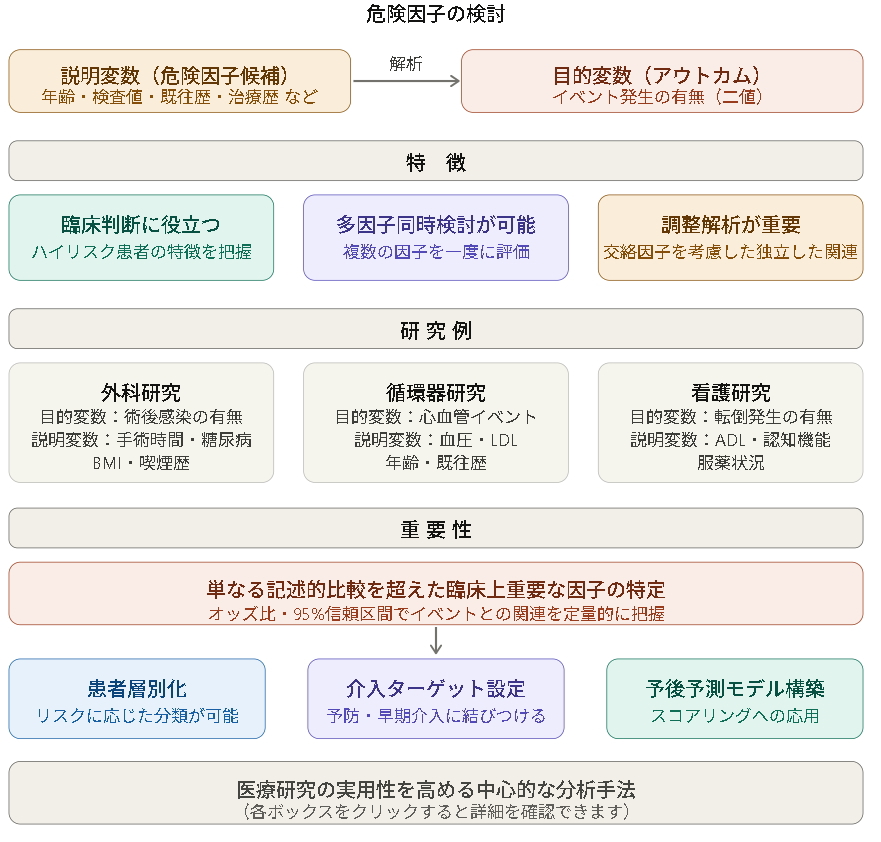
Characteristics of Risk-Factor Analysis
Useful for clinical decision-making: Identifying characteristics of high-risk patients can support prevention and early intervention.
Simultaneous assessment of multiple factors: Age, sex, laboratory values, medical history, treatment history, and other factors can be evaluated together.
Adjustment is important: Independent associations should be assessed while accounting for potential confounders.
Examples of Risk-Factor Analysis
Surgical research: Use postoperative infection as the outcome and analyze operation time, diabetes, BMI, and smoking history as explanatory variables.
Cardiovascular research: Examine associations between cardiovascular events and blood pressure, LDL cholesterol, age, and medical history.
Nursing research: Analyze the effects of ADL, cognitive function, and medication status on fall occurrence.
Importance of Risk-Factor Analysis
Risk-factor analysis isimportant for identifying clinically relevant factors beyond simple descriptive comparisons.Odds ratios and 95% confidence intervals can show concretely how strongly each factor is associated with event occurrence. Identified risk factors can also support patient stratification, targeting of interventions, and development of prognostic models.
Thus, risk-factor analysis is one of the central applications that increase the practical value of medical research.
Prognostic Analysis Incorporating Time
Prognostic analysis incorporating time is an important area unique to medical statistics. Medical outcomes often depend not only on whether something happened but when it happened—for example overall survival, progression-free survival, time to recurrence, length of stay from admission to discharge, or time from treatment initiation to an adverse event. Survival-analysis methods are used in these situations.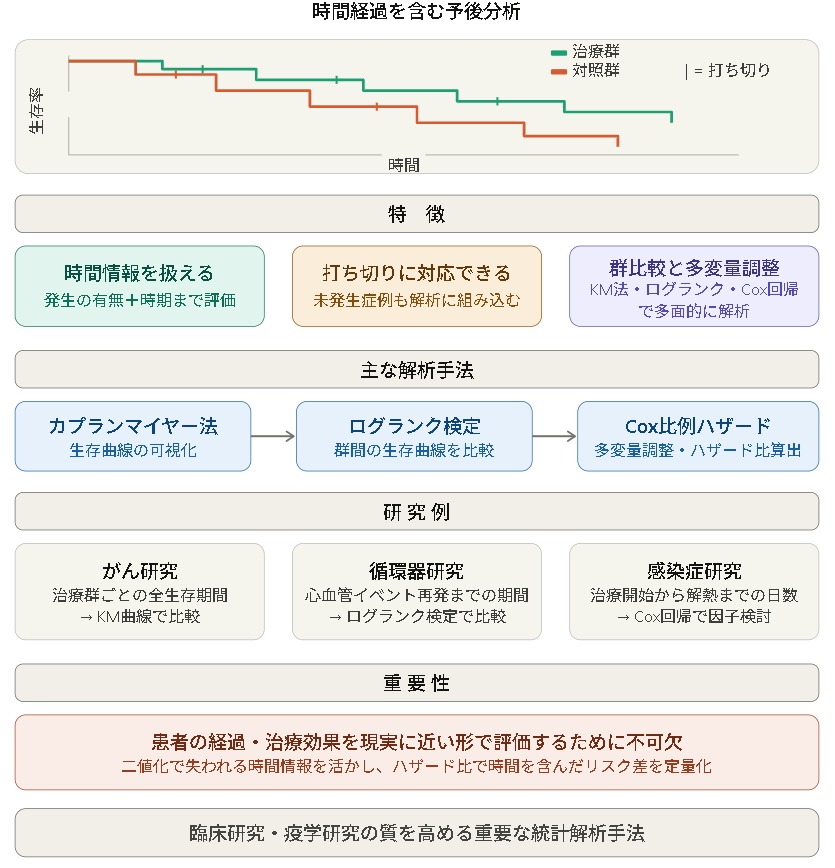
Characteristics of Time-to-Event Prognostic Analysis
Incorporates time information: Evaluates not only whether an event occurred but also when it occurred.
Handles censoring: Cases without an observed event during the follow-up period can still be included in the analysis.
Supports both group comparison and multivariable adjustment: Kaplan–Meier methods, log-rank tests, and Cox proportional-hazards models can be used for complementary analyses.
Examples of Time-to-Event Prognostic Analysis
Cancer research: Compare overall survival by treatment group using Kaplan–Meier curves.
Cardiovascular research: Compare time to recurrent cardiovascular events using a log-rank test.
Infectious-disease research: Use Cox regression to examine factors associated with time from treatment initiation to resolution of fever.
Importance of Time-to-Event Prognostic Analysis
Prognostic analysis incorporating time isessential in medical statistics for evaluating patient courses and treatment effects in a way that more closely reflects clinical reality.It preserves information that would be lost by converting outcomes into simple binary variables, allowing prognosis to be represented more carefully. Hazard ratios can also quantify relative risk over time.
Thus, time-to-event prognostic analysis is a highly important statistical approach for improving the quality of clinical and epidemiological research.
Contact Us
Over 30,000 consultations / Over 19,000 completed engagements. To date, we have supported consultations and requests involving analysis outsourcing, statistical processing, questionnaire surveys, marketing support, and more. Our experienced consultants carefully listen to your needs so that we can provide the right support. We offer prompt and accurate work at reasonable, accessible rates and are committed to delivering dependable results. Stat Agent team members across Japan will take responsibility for supporting you.
*We provide the profile of the person responsible for your project when you apply.
For outsourced analysis and statistical processing, choose Stat Agent.
0476-85-7930
*When order volume is high, it may be difficult to reach us by phone.
We apologize for the inconvenience. We respond in order of receipt, so if your matter is urgent, please contact us byemail .
*When order volume is high, it may be difficult to reach us by phone.
We apologize for the inconvenience. We respond in order of receipt, so if your matter is urgent, please contact us by
