
Practical Examples of M-GTAPractical M-GTA Example
Major Practical Applications of M-GTA
This section explains practical examples of M-GTA in qualitative research. M-GTA meansModified Grounded Theory Approachand is a qualitative method used to theoretically clarify processes and interactions within phenomena based on interviews, observation records, and related data. Practical M-GTA involves working with actual transcripts or open-ended responses to generate concepts, develop categories, and create relationship diagrams. It is used in nursing, education, welfare, medical-interview research, human-resource development, and many other fields.Practical Examples of M-GTA
Several representative applications are described below according to research population and purpose.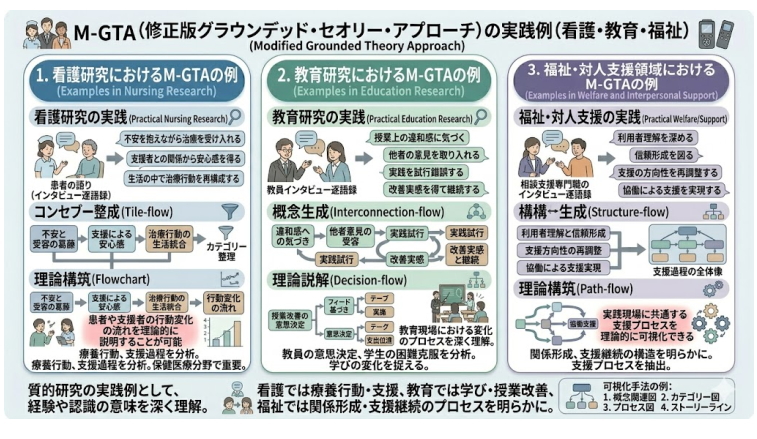
1. Example of M-GTA in Nursing Research:
In nursing research, M-GTA may be used to analyze the process through which patients with chronic illnesses continue treatment or the process through which nurses organize patient support. Researchers carefully read interview transcripts and may generate concepts such as “accepting treatment while experiencing anxiety,” “gaining reassurance through relationships with supporters,” and “reconstructing treatment behaviors within daily life,” then organize those concepts into categories. This makes it possible totheoretically explain patterns of behavioral change among patients and support providers.M-GTA is an important analytical method in nursing and other health-related qualitative research.
2. Example of M-GTA in Educational Research:
In educational research, M-GTA may be used to analyze teachers' decision-making processes in instructional improvement or how students overcome learning difficulties. For example, concepts such as “noticing discomfort with current teaching,” “incorporating others' views,” “experimenting with practice,” and “continuing after recognizing improvement” may be extracted from teacher-interview transcripts and their relationships organized. The method is useful for deeply understanding processes of change in educational settings.
3. Example of M-GTA in Welfare and Human-Support Fields:
In welfare and human-support research, M-GTA can analyze relationship formation between supporters and service users and the meaning assigned to continued support. For example, interviews with consultation-support professionals may generate concepts such as “deepening understanding of the service user,” “building trust,” “readjusting the direction of support,” and “achieving collaborative support,” allowing the overall support process to be depicted. Beyond simply organizing experiences, the method cantheoretically visualize support processes shared across practical settings.
Unlike quantitative statistical analysis, practical M-GTA can provide deep understanding of experiences, perceptions, and interactions that are difficult to express numerically. In nursing, it can clarify treatment behaviors and support processes; in education, learning and instructional-improvement processes; and in welfare research, relationship formation and continuity of support. Selecting an analytical theme appropriate to the research objective is important. Concept-relation diagrams, category diagrams, process diagrams, and storylines are often used to visualize M-GTA findings.
Example of M-GTA in Nursing Research
In nursing research, M-GTA can clarify processes in treatment and support from the narratives of patients and nurses. It is a representative practical application of qualitative research in medicine, nursing, and health sciences.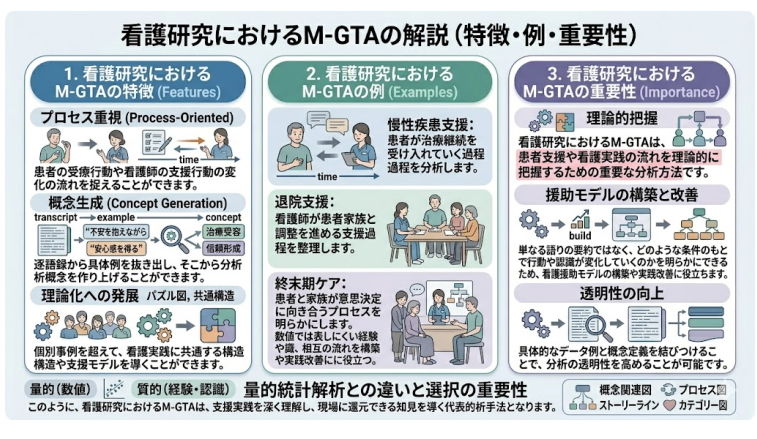
Characteristics of M-GTA in Nursing Research
Process-oriented: Captures changes over time in patients' healthcare behaviors and nurses' support actions.
Concept generation: Concrete examples are extracted from transcripts and used to develop analytical concepts.
Development toward theory: Common structures and support models in nursing practice can be derived beyond individual cases.
Example of M-GTA in Nursing Research
Chronic-illness support: Analyze the process through which patients come to accept continued treatment.
Discharge support: Organize the process through which nurses coordinate with patients and families.
End-of-life care: Clarify how patients and families engage in decision-making.
Importance of M-GTA in Nursing Research
In nursing research, M-GTA isan important analytical method for theoretically understanding processes in patient support and nursing practice.Rather than simply summarizing narratives, it can clarify the conditions under which behaviors and perceptions change, supporting development of nursing-support models and improvement of practice. Linking concrete data examples with concept definitions can also improve analytical transparency.
Thus, M-GTA in nursing research is a representative qualitative method for deeply understanding support practices and deriving findings that can be returned to the field.
Example of M-GTA in Educational Research
In educational research, M-GTA uses narratives from teachers, students, parents, and others to analyze processes of learning, instruction, and decision-making. It is useful for theoretically understanding change and growth in educational practice.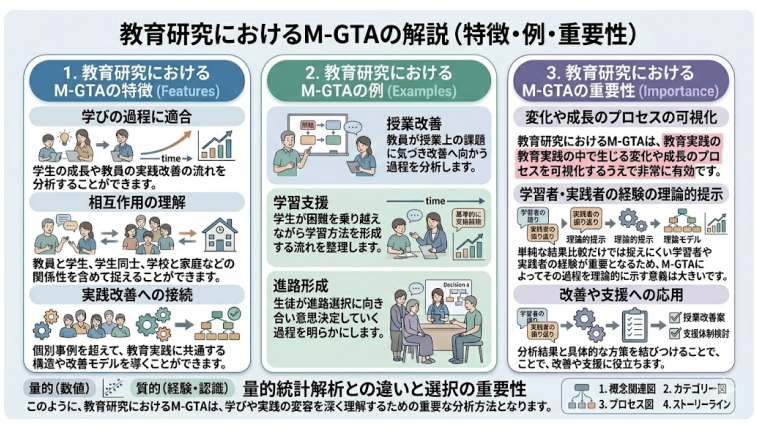
Characteristics of M-GTA in Educational Research
Fit with learning processes: Can analyze patterns of student growth and teachers' improvement of practice.
Understanding interactions: Can incorporate relationships between teachers and students, among students, and between school and home.
Connection to practice improvement: Findings can be readily linked to instructional improvement and educational-support strategies.
Example of M-GTA in Educational Research
Instructional improvement: Analyze how teachers recognize instructional problems and move toward improvement.
Learning support: Organize how students develop learning strategies while overcoming difficulties.
Career development: Clarify how students confront career choices and make decisions.
Importance of M-GTA in Educational Research
M-GTA in educational research ishighly effective for visualizing processes of change and growth that occur within educational practice.Because learners' and practitioners' experiences are important in education and can be difficult to capture through simple outcome comparisons, theoretically describing those processes with M-GTA is valuable. The method is also readily applicable to examining instructional improvement and support systems.
Thus, M-GTA is an important method for deeply understanding transformation in learning and practice.
Example of M-GTA in Welfare and Human-Support Fields
In welfare and human-support fields, M-GTA focuses on interpersonal interactions such as relationship formation between support providers and service users and the meaning of continued support. It is particularly useful in fields where the context of support practice is central.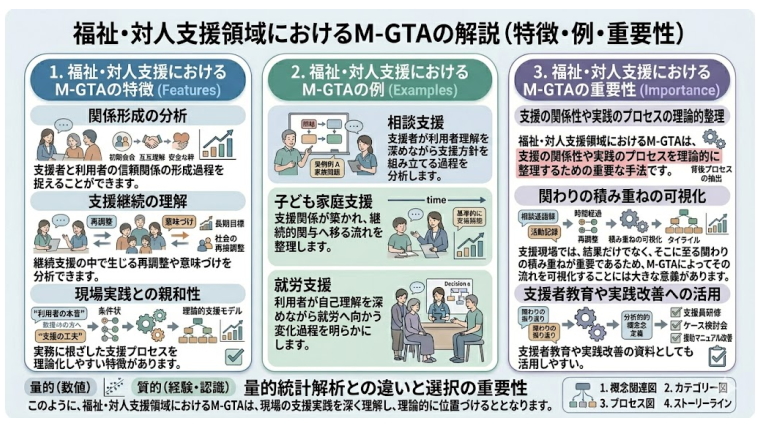
Characteristics of M-GTA in Welfare and Human-Support Fields
Relationship formation: Captures the process through which trust develops between support providers and service users.
Understanding continuity of support: Analyzes readjustment and meaning-making that occur during ongoing support.
Compatibility with field practice: Practical support processes can be theorized while remaining grounded in real-world practice.
Example of M-GTA in Welfare and Human-Support Fields
Consultation support: Analyze how support providers develop a support plan while deepening their understanding of the service user.
Child and family support: Organize the process through which a support relationship is established and develops into ongoing involvement.
Employment support: Clarify the process through which service users deepen self-understanding and move toward employment.
Importance of M-GTA in Welfare and Human-Support Fields
In welfare and human-support fields, M-GTA isan important method for theoretically organizing support relationships and practical support processes.In support settings, not only outcomes but also the accumulated interactions leading to those outcomes are important, making it highly meaningful to visualize those processes through M-GTA. The method can also be used as material for support-provider education and improvement of practice.
Thus, M-GTA is a core qualitative method for deeply understanding and theoretically positioning support practice in welfare and human-support fields.
Contact Us
Over 30,000 consultations / Over 19,000 completed engagements. To date, we have supported consultations and requests involving analysis outsourcing, statistical processing, questionnaire surveys, marketing support, and more. Our experienced consultants carefully listen to your needs so that we can provide the right support. We offer prompt and accurate work at reasonable, accessible rates and are committed to delivering dependable results. Stat Agent team members across Japan will take responsibility for supporting you.
*We provide the profile of the person responsible for your project when you apply.
For outsourced analysis and statistical processing, choose Stat Agent.
0476-85-7930
*When order volume is high, it may be difficult to reach us by phone.
We apologize for the inconvenience. We respond in order of receipt, so if your matter is urgent, please contact us byemail .
*When order volume is high, it may be difficult to reach us by phone.
We apologize for the inconvenience. We respond in order of receipt, so if your matter is urgent, please contact us by
