
4-Point vs. 5-Point Likert Scales | Key Differences and How to Choose
A practical guide to the differences between 4-point and 5-point Likert scales, including how the choice can affect analysis results.
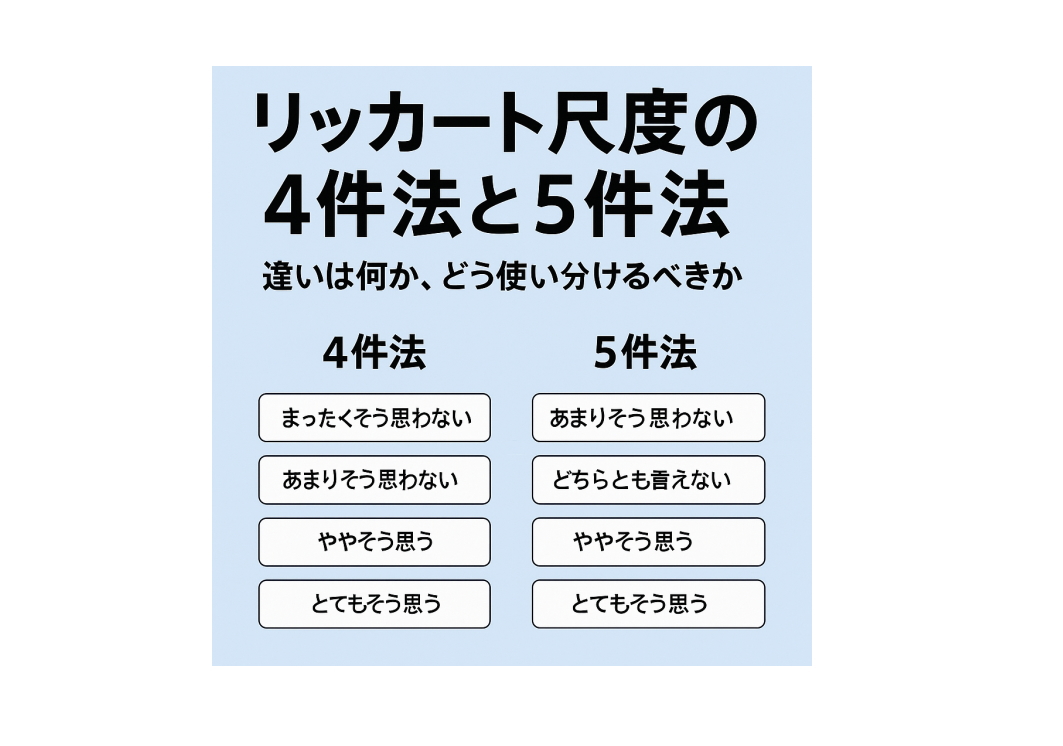
Likert scales are commonly used to measure satisfaction, attitudes, perceptions, psychological constructs, learning effects, service evaluations, and similar concepts. Two common formats are the 4-point and 5-point scales.
The main difference between a 4-point and 5-point scale iswhether a neutral response option is provided.This difference can affect not only respondent psychology but also tabulation results, means, factor analysis, reliability analysis, and interpretation in reports.
Neither the 4-point nor 5-point format is always the correct choice.The appropriate option depends on the survey objective, respondent burden, analytical method, and how the results will be used.These factors should guide the choice.
What is a Likert scale?
A Likert scale measures attitudes or perceptions using ordered response options such as from “strongly agree” to “strongly disagree.” It is widely used in psychology, education, nursing research, social surveys, customer-satisfaction studies, and other fields.
Likert item responses have ordinal properties, but when multiple items are summed or averaged into a scale score, they are sometimes analyzed in practice approximately as continuous variables, depending on the research field and purpose.
Differences between 4-point and 5-point scales
| 4-point scale | Does not include a neutral option and requires respondents to choose a directional response such as agreement or disagreement |
|---|---|
| 5-point scale | Can include a neutral midpoint such as “neither agree nor disagree” |
| Main difference | Whether respondents are required to indicate a direction or are allowed to express a neutral attitude |
A 4-point scale can be described as a forced-choice format, whereas a 5-point scale includes a neutral midpoint.
When a 4-point scale is appropriate
A 4-point scale is suitable when the researcher wants respondents to express a clear direction in their attitude, such as support or opposition to a policy, intention to use a service, or direction of improvement requests.
However, because truly neutral respondents are still required to choose one side, the format may increase respondent burden or make opinions appear stronger than they actually are.
When a 5-point scale is appropriate
A 5-point scale allows respondents to express neutrality or defer judgment, making it suitable for topics on which attitudes are not yet formed or surveys where respondent knowledge varies.
On the other hand, if responses cluster around “neither agree nor disagree,” patterns may become harder to identify. Clear question wording and well-designed response labels are therefore important.
Analytical cautions
Means, standard deviations, and distribution shapes may differ between 4-point and 5-point formats. The presence or absence of a neutral midpoint can particularly affect response bias and ceiling or floor effects.
When conducting factor analysis or reliability analysis, researchers should also check the number of items, response distributions, reverse-scored items, and handling of missing data.
Practical points in questionnaire design
- Consider a 4-point scale when the objective is to identify support versus opposition
- Consider a 5-point scale when you also want to measure ambiguous or neutral attitudes
- Keep response-option wording symmetric
- Use a consistent response direction across all items
- Combine with open-ended questions or demographic items to support interpretation
Frequently Asked Questions
Q1. Is a 4-point or 5-point scale easier to analyze?
Both can be analyzed. However, interpretation depends on the research objective and response distribution, so the design rationale should be clear before data collection.
Q2. Should a 5-point scale include “neither agree nor disagree”?
It is useful when a neutral attitude is substantively meaningful. If the survey aims to obtain a clear direction of support or opposition, a 4-point scale may be more suitable.
Q3. Can Likert-scale responses be analyzed using means?
A single item should be treated cautiously because it is ordinal. When multiple items are combined into a scale score, means may be used depending on the research field and objective.
Summary | Choose between 4-point and 5-point scales based on the survey objective
The major difference between 4-point and 5-point Likert scales is whether a neutral response option is available.
When designing a survey, consider whether respondents should be required to express a direction or whether neutral attitudes should also be measured, and make the choice with the planned analysis and reporting interpretation in mind.
