
ISM, DEMATEL, and Priority Methods
For those who want to structure complex factors and clarify priorities in undergraduate theses, master’s theses, doctoral dissertations, journal submissions, corporate studies, and policy research
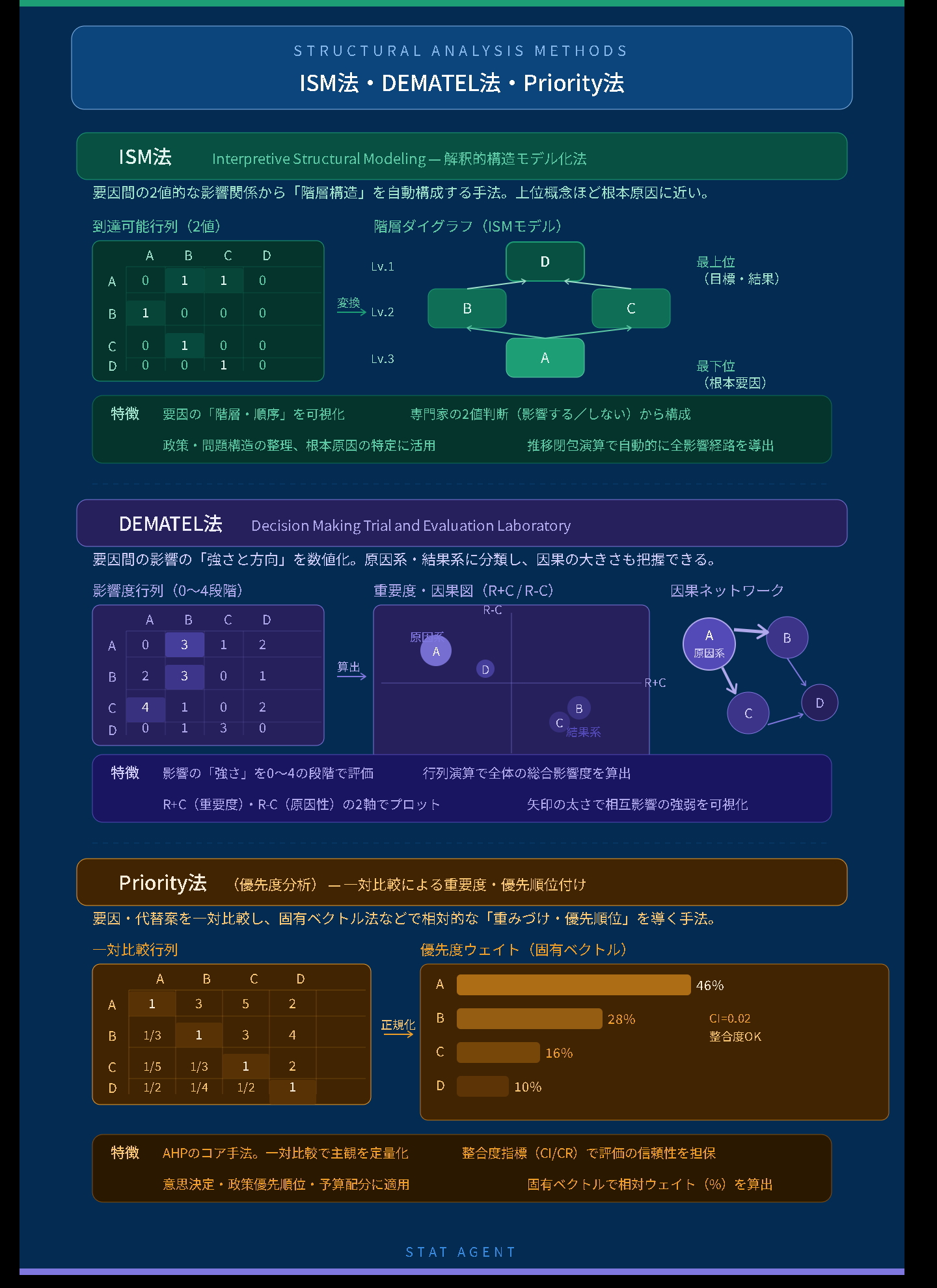
In research and practical investigations, multiple factors may be intricately interconnected, making it difficult to determine where to begin, which factors are root causes, and which interventions should be prioritized. In organizational reform, design management, improvements in medical and nursing settings, educational issues, regional policy, tourism promotion, welfare services, marketing strategy, digital transformation, and risk management, simple tabulation or correlation analysis may be insufficient to explain the problem structure.
Useful analytical methods in such situations include ISM,、 DEMATEL.、 the Priority Method, and DEMATEL. ISM organizes relationships among factors into a hierarchical structure, DEMATEL visualizes influence relationships among factors as a causal structure, and the Priority Method can be used to evaluate the priority of multiple factors or interventions according to research or practical decision-making objectives.
In particular, for factors extracted from qualitative research or a literature review, researchers can organize the hierarchical structure with ISM,、 analyze influence relationships and relation values with DEMATEL,、 and use the Priority Method to judge the priority of interventions or factors. This sequence can make complex problems easier to explain in research papers and reports.
This article is intended for readers considering ISM,、 DEMATEL.、 DEMATEL、 the Priority Method,、 hierarchical-structure analysis、 causal-structure analysis、 priority analysis、 factor analysis、 survey analysis、 expert evaluation For readers searching for these topics, this article explains the differences among the three methods, how to combine them, analytical procedures, how to report them in papers, and key cautions.
The first point to understand is that ISM is “a method for placing factors into a hierarchy,” DEMATEL is “a method for visualizing influence relationships among factors,” and the Priority Method is “a method for judging the priority of factors or interventions.” Using these methods appropriately allows complex research topics to be explained from three perspectives: structure, causality, and priority.
- • What is ISM?
- • What is DEMATEL?
- • What is the Priority Method?
- • Differences among ISM, DEMATEL, and the Priority Method
- • Analytical procedure for combining the three methods
- • Examples of application to research topics
- • Use in surveys and expert evaluations
- • How to write the Methods and Results sections
- • Analytical cautions and limitations
- • Analytical support available from Stat Agent
- • Frequently Asked Questions
- • Summary
What is ISM?
ISM stands for Interpretive Structural Modeling and is a method for organizing relationships among multiple factors and visualizing them as a hierarchical structure. It is used to determine, within the factors constituting a complex problem, which factors precede others and which are positioned at higher or lower levels.
In ISM, the factors to be analyzed are first defined and the presence or absence of relationships between pairs of factors is determined. These relationships are then organized into a matrix, and a hierarchy is constructed while examining reachability. This makes a complex problem easier to understand in terms of upper-level, middle-level, and lower-level factors.
For example, in research on regional revitalization involving factors such as “population decline,” “shortage of local actors,” “underuse of regional resources,” “insufficient information dissemination,” “decline in tourists,” and “insufficient administrative collaboration,” ISM can hierarchically organize which factors lie in the underlying background and which appear as outcomes.
What ISM can reveal
ISM reveals hierarchical relationships among factors. Rather than merely listing factors, it organizes upper, middle, and lower levels based on their interconnections. It is therefore useful when explaining the overall picture of a research topic or showing how multiple factors accumulate to form a problem.
ISM can be applied to exploratory research, structuring policy issues, organizing organizational problems, analyzing issues in education, welfare, and healthcare settings, and organizing strategic business challenges. Because factor relationships can be presented graphically, it also helps communicate problem structure intuitively to readers of research papers and reports.
Reachability matrices and hierarchical structuring
In ISM, relationships among factors are organized using an adjacency matrix and a reachability matrix. An adjacency matrix indicates whether Factor A is related to Factor B. A reachability matrix incorporates not only direct relationships but also indirect reachability through other factors.
Based on reachability, factors are classified into hierarchical levels. Factors at higher levels may be interpreted as background or root factors that influence others, while lower-level factors may be interpreted as outcome factors that emerge under the influence of higher-level factors.
What is DEMATEL?
DEMATEL stands for Decision Making Trial and Evaluation Laboratory and is a structuring method for analyzing the extent to which multiple factors influence one another. Whereas ISM is strong at organizing hierarchical structure, DEMATEL characteristically identifies the direction and strength of influence among factors and distinguishes causal-side from effect-side factors.
In DEMATEL, experts, practitioners, or other relevant evaluators rate the extent to which Factor A influences Factor B. The ratings are organized into a matrix, and a total-relation matrix is calculated to incorporate both direct and indirect influence. This reveals which factors strongly influence others and which are more readily influenced by other factors.
What DEMATEL can reveal
DEMATEL reveals influence relationships among factors. Specifically, measures such as dispatching influence, receiving influence, prominence, and relation can be calculated to examine central factors and factors positioned on the causal side of the problem structure.
For example, a study of corporate digital-transformation promotion might consider factors such as “management understanding,” “frontline resistance,” “shortage of digital talent,” “complexity of business processes,” “investment decisions,” and “organizational culture.” DEMATEL can help identify which of these factors act as starting points that drive other factors.
Prominence and relation (cause degree)
In DEMATEL, prominence and relation are important indicators. Prominence shows how strongly a factor is connected within the overall network. A factor with high prominence may lie at the core of the problem structure.
Relation indicates whether a factor tends to influence other factors or to be influenced by them. A high positive relation value is generally interpreted as a relatively causal-side factor, whereas a lower or negative relation value is interpreted as relatively effect-side.
What is the Priority Method?
The Priority Method is an approach used in research and practice to judge the priority of multiple factors, issues, interventions, or improvement proposals. However, the term “Priority Method” may have different meanings across fields and researchers. Therefore, when using it in a paper, it is necessary not merely to name the method but to explain clearly the criteria used to calculate or determine priority.
Typically, criteria such as importance, urgency, impact, feasibility, cost-effectiveness, risk, and effects on stakeholders are defined, and each item is evaluated to determine priority. Depending on the research objective, priority may be calculated using expert evaluation, surveys, pairwise comparisons, scoring, or weighted assessment.
Using the Priority Method after structuring a problem with ISM or DEMATEL makes it possible to move beyond simply choosing factors that “seem important” and instead judge which factors or interventions should be prioritized in light of the hierarchical and causal structures. This supports more structured decision-making.
Differences among ISM, DEMATEL, and the Priority Method
ISM, DEMATEL, and the Priority Method can all be used to organize complex problems, but their purposes differ. ISM hierarchically structures factors, DEMATEL visualizes influence relationships among factors, and the Priority Method judges the priority of factors or interventions.
| Method | Primary purpose |
|---|---|
| ISM, | Organize relationships among factors as a hierarchical structure |
| DEMATEL. | Visualize the direction and strength of influence among factors as a causal structure |
| the Priority Method, | Judge the priority of multiple factors or interventions |
| Suitable situations | When you want to structure a complex issue and consider the priority of improvement measures or research hypotheses |
For example, ISM can organize “which factors are higher and which are lower” in the structure. DEMATEL can organize “which factors strongly drive other factors.” The Priority Method can organize “which factors or interventions should receive priority when resources are limited.”
Accordingly, the three methods are not competitors; they can be used complementarily according to the research objective. One possible design is to extract factors from qualitative analysis or a literature review, organize their hierarchy with ISM, analyze influence relationships with DEMATEL, and finally use the Priority Method to present priorities for interventions.
Analytical procedure for combining the three methods
When combining ISM, DEMATEL, and the Priority Method, it is important to design the analytical sequence according to the research objective. Generally, factors are first extracted from a literature review, interviews, open-ended responses, expert interviews, or similar sources. Relationships among the factors are then organized and hierarchical or causal structures are analyzed. Finally, priorities are considered based on the results.
| Stage | Main Task |
|---|---|
| 1. Factor extraction | Organize major factors from prior literature, interviews, open-ended responses, and expert interviews |
| 2. ISM | Convert relationships among factors into a matrix and visualize them as a hierarchical structure |
| 3. DEMATEL | Evaluate the direction and strength of influence among factors and calculate prominence and relation |
| 4. Priority Method | Calculate priorities based on importance, impact, feasibility, and related criteria |
| 5. Interpretation and recommendations | Organize interventions, improvement proposals, and research implications based on structural-analysis results |
This process enables an integrated explanation of factor hierarchy, causal influence relationships, and intervention priorities rather than merely listing factors. In doctoral dissertations and journal submissions, transparency of the analytical process is important, so researchers should clearly state what data were used at each stage, who performed the evaluations, and what criteria were used to calculate priority.
Examples of application to research topics
ISM, DEMATEL, and the Priority Method are suitable for research addressing complex problem structures. They are particularly useful when multiple factors interact and the study also aims to examine intervention priorities.
| Research field | Example applications |
|---|---|
| Management studies | Structural analysis of factors related to design management, digital-transformation promotion, organizational change, turnover prevention, and improved customer satisfaction |
| Education | Organizing factors related to learning motivation, class improvement, school-refusal support, declining interest in teaching careers, and educational disparities |
| Medicine and nursing | Analysis of factors related to team-based care, patient safety, nurses’ workload, and improvement of healthcare settings |
| Welfare and regional policy | Prioritization of issues in community-based integrated care, child support, disability support, municipal policies, and regional challenges |
| Marketing | Analysis of customer satisfaction, brand evaluation, purchasing behavior, service improvement, and factors shaping word of mouth |
For example, in a study of design management in small and medium-sized enterprises, factors such as “management understanding,” “design personnel,” “organizational culture,” “customer understanding,” “external collaboration,” and “investment decisions” can first be extracted from a literature review and interviews. ISM can then organize the factor hierarchy, DEMATEL can analyze influence relationships among factors, and the Priority Method can identify which interventions should receive priority under limited management resources, leading to recommendations that are persuasive both academically and practically.
Use in surveys and expert evaluations
When ISM, DEMATEL, and the Priority Method are used, surveys or expert evaluations may be conducted to assess relationships among factors and the strength of influence. Evaluators are commonly researchers, practitioners, managers, professionals, or frontline personnel who are knowledgeable about the target topic.
In ISM, evaluators judge whether Factor A and Factor B are related and which precedes the other. In DEMATEL, they rate how strongly Factor A influences Factor B on an ordinal scale. In the Priority Method, they evaluate the priority of factors or interventions according to criteria such as importance, urgency, feasibility, cost-effectiveness, and risk.
One caution is that respondent burden increases as the number of factors grows. With ten factors, there are already many pairwise relationships to evaluate. It is therefore important to narrow the factors in advance and design evaluation items that are easy to understand.
How to write the Methods and Results sections
When ISM, DEMATEL, and the Priority Method are used in a paper, the Methods section should clearly explain the analytical procedure and the Results section should present the structural-analysis findings step by step. In particular, researchers should state how factors were extracted, evaluator characteristics, rating scales, matrix-construction methods, procedures for hierarchy and prominence/relation calculations, and the criteria for determining priorities.
- Major factors for analysis were extracted based on prior research and expert interviews.
- The hierarchical relationships among the extracted factors were organized using ISM.
- Expert evaluation of influence relationships among factors was conducted, and DEMATEL was used to calculate prominence and relation.
- The priority of interventions was evaluated using the Priority Method in terms of importance, impact, and feasibility.
- Based on the analysis results, causal-side factors, central factors, and interventions requiring priority action were identified.
In the Results section, an ISM hierarchical-structure diagram, a DEMATEL table of prominence and relation, a causal-structure diagram, and a Priority Method ranking table can make the findings easier for readers to understand. In the Discussion, explain what higher-level and causal-side factors mean for the research topic and why high-priority interventions are important, relating them to prior research and field context.
Analytical cautions and limitations
Although ISM, DEMATEL, and the Priority Method are useful, their results should not be interpreted too definitively. These methods organize relationships and influence structures among factors; they do not establish rigorous causal effects in the way experimental studies do.
Results may also vary depending on evaluator selection. The number of experts, their areas of expertise, practical experience, and understanding of the rating criteria can influence findings, so papers should carefully describe evaluator characteristics and the reasons for their selection.
For the Priority Method, it is particularly important to define the criteria used to calculate priority. Results will differ depending on whether ranking is based only on importance or also includes feasibility and cost-effectiveness. Therefore, the criteria used to judge priority should be clearly specified and their appropriateness for the research objective explained.
Analytical support available from Stat Agent
Stat Agent provides support for ISM, DEMATEL, the Priority Method, qualitative analysis, questionnaire design, expert evaluation, causal-structure diagrams, hierarchical-structure diagrams, priority tables, interpretation of results, and reporting in papers and reports for undergraduate theses, master’s theses, doctoral dissertations, journal submissions, medical papers, nursing research, education research, management research, social surveys, municipal surveys, and corporate studies.
When ISM, DEMATEL, and the Priority Method are combined in particular, we can support the full process from factor extraction, evaluation-form design, matrix-data preparation, hierarchical structuring, calculation of prominence and relation, prioritization, figure and table creation, and writing of the Methods, Results, and Discussion sections. This process can be organized consistently from beginning to end.
We can also provide specific consultation for concerns such as “I want to create an ISM hierarchical-structure diagram,” “I am unsure how to interpret DEMATEL prominence and relation,” “I want to show intervention priorities using the Priority Method,” or “I want an analysis design suitable for a doctoral dissertation or journal submission,” based on your research objective and data.
Frequently Asked Questions
Q1. Are ISM and DEMATEL the same method?
No. ISM organizes relationships among factors as a hierarchical structure. DEMATEL analyzes the direction and strength of influence among factors and visualizes causal-side and effect-side factors.
Q2. What is the Priority Method used for?
The Priority Method is used to judge the priority of multiple factors or interventions based on importance, urgency, impact, feasibility, and similar criteria. When used in a paper, the criteria used to determine priority must be explained clearly.
Q3. Can ISM, DEMATEL, and the Priority Method be combined?
Yes. For example, ISM can organize the hierarchical structure of factors, DEMATEL can analyze influence relationships, and the Priority Method can determine intervention priorities. However, the methods used should be selected according to the research objective.
Q4. Can these methods alone prove causality?
No, not in the strict causal-inference sense. ISM and DEMATEL organize structures and influence relationships among factors. Their interpretation should be distinguished from causal inference based on experimental or longitudinal studies.
Q5. Can these methods be used in undergraduate or master’s theses?
Yes. However, the number of factors and evaluators, the analytical procedure, and the methods for creating figures and tables should be designed at a manageable level. The analysis should be appropriate to the supervisor’s policy and conventions in the research field.
Summary | ISM, DEMATEL, and the Priority Method are effective for structuring complex research topics and identifying priorities
ISM, DEMATEL, and the Priority Method are useful for organizing research topics involving complex interacting factors. ISM clarifies the hierarchical structure of factors, DEMATEL visualizes influence relationships and relation values, and the Priority Method helps determine the priority of interventions or factors.
Combining these methods makes it easier to build a research design that consistently explains factor extraction, hierarchical structuring, causal-structure analysis, and prioritization. This is particularly useful for topics involving multiple interacting factors in management, education, medicine and nursing, welfare, regional policy, marketing, and design management.
Stat Agent provides support for ISM, DEMATEL, the Priority Method, qualitative analysis, questionnaire design, expert evaluation, figure and table creation, statistical analysis, and reporting in academic papers and reports. I want to organize complex factors into a hierarchical structure.、 I want to visualize influence relationships using DEMATEL.、 I want to clarify priorities using the Priority Method. Please feel free to contact us in these situations.
